Sunday, September 13, 2009

Cawdor Castle

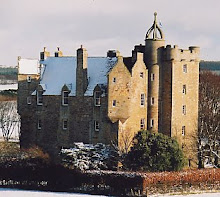
Yesterday I spent a happy late afternoon in the Cawdor Castle gardens, trying out a new camera.

For many the word 'Cawdor' brings just a faint echo of 'Thane of Cawdor' in Shakespeare's 'Macbeth'. In fact Macbeth became king of Scotland in 1040; and so long before the castle was built (circa. 1400) or even the first Thane appointed (1295).


Cawdor has a golden thread of authenticity: built by the third Thane, it is now the winter home of the 25th Thane's widow. It is also a stylish survivor: despite the Battle of Culloden ten miles away and the Battle of Auldearn six miles away the castle is undamaged by battle or ill-advised additions and has grown in sympathy with the original architecture. Today the castle shows how history, art, fine gardens, gracious 21st century living and a successful visitor attraction may be happily combined.

And the golden thread is there for those who look. The thorn tree, over which the castle was built in 15th century, (whereby hangs a tale) is still there; radio carbon dating confirms it. The joining of the families of Cawdor and Campbell in the early 16th century is in the crest above the drawbridge: Campbell Motto, Cawdor crest. That's another tale - one of kidnap, mutilation, murder and a surprisingly happy marriage!

And above the main entrance is the coat of arms of Sir Hugh, 15th Thane. He married Henrietta Stewart whose arms, including the familiar red lion rampant, are on the right. Their 17th century marriage bed, recently reconditioned, is on display in the castle.

As I wandered round the gardens, I started to notice dates. An aromatic herb native to North America, collected in 1744. Lavender beds laid out by the Lady Cawdor of that time in 1850. The holly maze, planted in 1981. And one part of the Rose Garden is closed as it is currently being reconstructed. And so it continues. An age away from Lady MacBeth and her devilish plotting.

Wednesday, August 26, 2009

Release of Abdelbaset Ali Mohmed al-Megrahi

Scotland finds itself blinking in the spotlight of international attention. The land of tartan, whisky, clans and castles suddenly has a role on the world stage.

So how did this unusual situation come about?

Well, it all goes back to the Union of Scotland and England to form a United Kingdom in 1707. Scotland was very much the weaker party and was out-negotiated on the all the important issues such as trade, tax and political representation. We did however hold on to institutions that were important to us: our own education system, our own established church and our own legal system.

Until Prime Minister Tony Blair gave Scotland its own parliament and a degree of devolution, justice here was in the hands of the Secretary of State for Scotland, a member of the UK Government. But since 1999 we have elected our own Scottish administration to deal with health, education, prisons, environment ... and justice.

'And so', I am asked, 'is all this going to affect tourism?'
Well I really cannot imagine so. I fully understand the strong feelings expressed, but this release does not reflect any groundswell of pro-Libyan opinion in Scotland. Far from it. This is one man's decision, flowing from a long established and compassionate legal system. Right or wrong, it is now a fait accompli and the Scottish Government is unlikely to have a similar decision to take in the next 500 years.

In my view the big loser in all of this is Libya: that country has missed a unique opportunity to raise its standing in the world by demonstrating dignity, gratitude and respect for the dead.

Saturday, August 22, 2009

Château de Grimaud

We had just under two hundred people in Edinburgh during The Gathering - a busy time for our small company. And once everyone was safely back home, I took a few welcome days off in the South of France. Castles continued to call though, and I climbed up to the Château de Grimaud, dramatically overlooking the Gulf of St Tropez. I had thought it was a Saracen fortress, but it was actually built by the king's grand sénéchal, Jean de Cossa in the 15th century. Essentially a medieval castle, it has massive towers with firing slits and high walls surrounded by a long stretch of crenelated ramparts up to seven metres high. In 1791 the French Revolutionaries confiscated and then demolished this aristocrat’s residence and it has been a noble ruin ever since. There are great views but the lack of maintenance and any interpretation made me realise what an excellent job Historic Scotland do for us and our visitors.


But the charm of Grimaud village with its colourful alleyways and a game of boules in the shade of the plane trees is something we may struggle to match!

Wednesday, August 05, 2009

A Funeral by Loch Ness

The redcoats stopped when they saw the funeral. A troop of six was escorting the bread wagon to Inverness and any gathering of Highlanders was worth a look in 1746 - there might be a wanted man, an illegal weapon. If nothing else, there was no harm in emphasising who controlled the food supplies, controlled the Highlands, following the Battle of Culloden earlier that year.

The ragged group around the coffin huddled closer, guarding what dignity remained to them. The priest looked up, paused and continued. Dismounted troopers were moving round for a better view. As they did so, an old woman swept a loaf of bread from the back of the cart into her dark shawl. Someone shouted. The woman ran. Troopers cocked their weapons. The funeral party dived behind gravestones. A shot rang out. Then another. Someone was hit…

It wasn’t a major incident in that incident-rich year. But it left its mark. Three marks in fact – the pits made by bullets on the gravestone of a James Fraser, buried in 1730.

It is not easy to bring the past to life, but last week my Outlander Tourists (fans of Diana Gabaldon’s Outlander books) were able to touch some little marks of conflict, unchanged, unrepaired, largely unnoticed since that fateful year of suppression.

Saturday, July 18, 2009

Basking at Inverness Highland Games

There was a distinctly Basque feel to this year's Inverness Highland Games. Guests Nazioen Mundua supplied music, dance, strongmen, wood choppers and a yoaldunak band - who play their instruments with their bums (actually just one instrument and just one note but impressively loud). This unmissable display punctuated my personal highlight of the games, a quiet (well it was meant to be quiet) drink with best selling author Diana Gabaldon who was doing a book signing in the clan village.

Diana's novels must have brought thousands of extra tourists to Scotland, exploring the romance of 18th century Highland living, hoping perhaps to meet her dashing, scholarly, gentlemanly (and above all sexy) hero, Jamie Fraser.
I have been running guided tours for fans of the novels for several years now and it was an enormous pleasure to meet the softly spoken, highly engaging, creator of the series - so interested in this distant world where she is a celebrity guest. I'm looking forward to continuing our conversations, without the unforgettable accompaniement of the yoaldunak.

Incidentally if you would like to see the yoaldunak being performed in a Basque village, rather than the Clan Village, click here (and wait a minute or so for it to load).

Sunday, July 12, 2009

An Edinburgh citizen with a gift for words.

A leather-bound volume offers this overview of Edinburgh...

"For centuries it was a capital thatched with heather, and more than once, in the evil days of English invasion, it has gone up in flame to heaven, a beacon to ships at sea. It was the jousting-ground of jealous nobles, not only on Greenside, or by the King's Stables, where set tournaments were fought to the sound of trumpets and under the authority of royal presence, but in every alley where there was room to cross swords, and in the main street, where popular tumult under the Blue Blanket alternated with the brawls of outlandish clansmen and retainers."

And of its citizens...

"To see them thronging by, in their neat clothes and conscious moral rectitude, and with a little air of possession that verges on the absurd, is not the least striking feature of the place."

The author was Robert Louis Stevenson (1850 - 1894) whose book, simply titled 'Edinburgh' should, in my view, be compulsory reading for every Edinburgh tour guide - and for any would-be wordsmiths tempted to write a guidebook on our capital city.

Wednesday, July 08, 2009

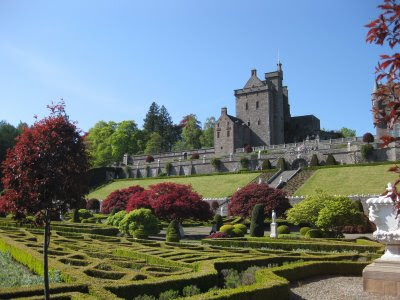
One Old Jacobite and formal terraced gardens

One of my heroes is George Keith, the last Earl Marischal of Scotland. Born into one of the great offices of state, with extensive lands round Dunnottar Castle, he had a good life in store. But in 1715, aged 23, he risked it all by declaring for the Jacobites. He commanded the right wing cavalry at Sherrifmuir - an extraordinary battle in which the right wings of both armies routed the other side; the Jacobites had the superior numbers but, under the bumbling leadership of the Earl of Mar, failed to hold the ground and the government forces took the day. Along with other dispirited Jacobite leaders, Keith retired that night to nearby Drummond Castle, home of the Duke of Perth.

I was there two weeks ago. Looking out on the fine formal terraced gardens it was hard to imagine the despair of brave men contemplating defeat, attainder, life-long exile, the loss of everything that they couldn't carry with them.

George Keith went on to have a long and varied life. He returned to Scotland from Spain as leader of the 1719 Jacobite rising and later was a roving ambassador for his exiled king. His travels took him to the court of Empress Catherine II of Russia and when that court was purged of foreigners he went to Prussia, eventually becoming Frederick the Great's ambassador to Paris. Here, in 1745, he tried hard (with the benefit of bitter experience) to dissuade Prince Charles Edward from making an attempt at the throne without foreign help.


He retired to a life of intellectual debate and the tending of plants at Frederick's Potsdam Palace, Sans Souci (above). In his eighties he was still writing energetically to friends in Scotland. Ultimately, it seems, he was far more at home amongst the sophistication (and yes, the formal terraced gardens) of Sans Souci than he was in the wave-lashed fortress of Dunnottar Castle which would otherwise have been his inheritance.


Tuesday, June 16, 2009

Hats off to Clans & Castles!

Just arrived...

"We just completed an extraordinary 10-day family vacation in Scotland based on a customized itinerary developed with the expert services of Scottish Clans & Castles. The trip was a mix of city and country with a terrific blend of classic and modern hotels, as well as two top-notch B&B’s, namely Brough House (Elgin) and Ethie Castle (Arbroath). The arrangements were flawless, the accommodations perfect and it appeared to us that they were able to secure the rooms with the best views, every single time. To us, this was an unexpected benefit of dealing with a local expert and a reflection of the intimate knowledge of their recommendations. Dealing with Alastair and his team in planning this memorable trip was a wonderful experience and we are looking forward to returning, hopefully sooner than later. Hats off to Clans & Castles!"

I hate self congratulatory blogs! But the above is a nice (unedited) word of appreciation. Now and again it is good to wave a flag. We are in business after all!

We enjoyed looking after the VanderPlaat family from Canada since we had a clear brief which included accommodating the requirements of two children, seeing round the privately-owned Dunderave Castle (above) and also visiting the Perthshire estate from which Jane VanderPlaat's family had emigrated three generations ago. It all seemed to work very well.

Many thanks to all our excellent hotels and B&Bs.

Friday, June 12, 2009

Dunollie Castle. In need of a Little TLC.

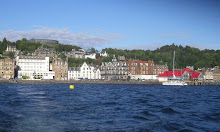
Camouflaged in the intense green scenery of Oban Bay is Dunollie Castle, seat of the MacDougalls, senior branch of the sons of Somerled, but one that opposed Robert the Bruce and suffered grievously for it. I was in Oban on Tuesday for a meeting of Scotland's Tourism Innovation Group; and as you can see, the weather was sensational.

They lost a lot, but the MacDougalls kept hold of Dunollie and the island of Kerrera from which this photo was taken; they also kept hold of the Brooch of Lorne, famously snatched from King Robert at Dalrigh, and still in the possession of the clan.

Dunollie, a place of pilgrimage for the clan, is badly in need of restoration. And the Brooch of Lorne, a clan icon for 700 years, is playing its part in raising funds as the talisman of a play 'The Hidden Jewel' to be performed at the castle 17 to 23 July 2009. Tickets and more detail here.

Another MacDougall initiative is the Hope MacDougall Collection, a remarkable collection of artefacts reflecting domestic and working life in the Highlands and Islands over the past 200 years. A selection is currently on display in a shop on George Street. More here.

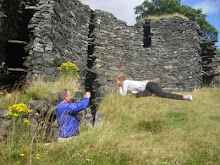
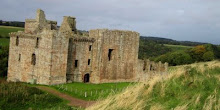
Dunollie badly needs help; and happily the MacDougalls have some impressive form in the field of restoring castles. In May 2006 remote Gylen Castle (below), on the southern tip of Kerrera and ruinous since 1647, was opened to the public. Let's hope they can pull it off again.

It was alsoat Gylen that the Brooch of Lorne was stolen by the Campbells of Lochawe. But that is another story...

Sunday, June 07, 2009

The Gathering of the Clans


In seven weeks time The Gathering of the Clans 2009 will be over: the first such event since George IV visited Edinburgh in 1822 - and set the kilt on its road to recovery after its banning following Culloden. In seven weeks the last caber will have been tossed, the last piobaireachd played; the March up the Royal Mile and the Clan Pageant at Edinburgh Castle will be a mass of colourful and inspiring photographs dominating the Sunday newspapers and, in due course, Scottish magazines worldwide.

You can still be there if you would like! Just drop us a line and we'll fix it for you.

Thursday, May 28, 2009

The Butter Castle


It had been a great stay on Mull - Duart Castle (above), sea eagles, otters, and an afternoon of hot sun! Leaving the Fishnish ferry at Lochaline I almost drove off the road at the sight of a beautifully restored tower house. Correctly termed Kinlochaline, the locals call it 'Butter Castle'.

This was a MacInnes castle. It was said that one of the clan women Dubh-Chal (Lady of the Black Veil) paid the architect an amount of butter equal in size to the castle, hence the name, Caisteal an Ime, or Castle of Butter. A carving, thought to be Dubh-Chal, is above the fireplace.


In the 14th century, Chief MacInnes of Ardgour was foster father and counsellor to John, Lord of the Isles. MacInnes had advised John to divorce Amy MacRuari and marry Margaret Stewart, daughter of the future King Robert II of Scotland. Then Amy got her revenge by relating that MacInnes had complained, when he stayed at John's house, that ‘his quarters did not smell well because they were used as a dog's kennel’.

John was duly enraged and ordered Donald MacLean of Duart to kill MacInnes. This he did, also killing MacInnes’ five sons and so gaining possession of Ardgour.

The Clan never recovered and has not had a chief since. In 1997, Sir Lachlan MacLean of Duart and Morvern offered an apology to Clan MacInnes President William MacInnis.

The castle, ruinous from 1644 until the 20th century, is now a family home.

Saturday, May 09, 2009

Alasdair mac Mhaighstir Alasdair (c.1695 – 1770)

I was in Arisaig today, enjoying the wonderful views out to Eigg, Rhum, Skye and Canna. I also noticed a plaque on the wall of the ruined 16th century church, 'Cill Mha'ru'...


More detail on Alasdair mac Mhaighstir Alasdair is in an excellent article on Wikipedia. He was some man: poet, Jacobite officer, student of Greek and Roman literature, publisher of the first Gaelic/English dictionary, Gaelic tutor to Bonnie Prince Charlie.

Not bad for a man who never went to school but was taught at home by his father!

Alasdair mac Mhaighstir Alasdair's name also points up a problem. 'Mac' is the Gaelic for 'son of ', thus Alasdair's father was Maighstir Alasdair (in English, Rev. Alexander MacDonald). Alasdair was 100% MacDonald (first cousin to Flora MacDonald), but there was no convention of surnames in 18th century Arisaig. Had Alasdair given up hiding from the redcoats and instead taken a boat to North Carolina, the clerk writing out the passenger list would probably have abbreviated the name to 'Alasdair mac Mhaighstir' or even Alasdair MacMaster. Quite a challenge therefore for any descendants tracing their roots!

Sunday, April 19, 2009

Which way is it to Obar Dheathain?

Spring has arrived in the Highlands. The fields are green. The geese have left and the ospreys are back. The snow is fast disappearing and the salmon are running nicely in the meltwater. All of this brings tourists flocking to Inverness Airport.

Now then, leaving with the rental car do they head for Inbhir Nis or Obar Dheathain?

Well of course translations are helpfully provided, but the arrival of Gaelic signage is a guaranteed topic of conversation at Highland dinner tables ("What the hell is the point? No-one understands Gaelic!").

So I though I'd put in my two pennyworth...

We've had a few tussles with the French but so far as I know have never tried to re-christen Paris as 'Paree' or Marseilles as 'Marsay'. And so why did Inbhir Nis have to become 'Inverness' - a poor phonetical rendering of a perfectly good Gaelic name? Of course French is a far better established language than Gaelic, but you get the point: 'Inverness' is not a 'real word' in any language. At least the USA retained the correct spelling of Orléans, even if they can't pronounce it!

Most mountains, like Glencoe's Buachaille Etive Mhor, (the big Shepherd of Etive), have retained their Gaelic integrity. And there are placenames, like 'Fort Augustus', that are pure English. No problem there. Its the large grey area in the middle...

So what's it all about?

The problem is that Gaelic is currently spoken by only about 60,000 people. If it reaches the stage of being nursed along by a few academics and enthusiasts, it will be dead in all but name. This matters because it was Scotland's principal language from the sixth to the sixteenth century and the vast majority of long established placenames are from the Gaelic. From these names we understand more of both our culture and our countryside. Let Gaelic go and we lose not just an impressive body of literature and song, but slice of social history.

The heavy responsibility of saving the language lies with Bòrd na Gàidhlig and their focus is of course on Gaelic medium schooling. But increasing awareness of Gaelic names is an important part of the process. Hence the road signs.

I see that Historic Scotland has recently restored the original Gaelic name of the Calanais Stones (previously anglicised as Callanish). It all helps.

Tapadh Leat airson leabadgh seo!

Friday, April 03, 2009

Harthill Castle

Each time I go down the A93 to Aberdeen, my eye is taken by the pink walls of Harthill Castle near Oyne - four stories and a garret, its bartizans tower above the surrounding trees. Today, for the first time, I arranged to take a couple of photos. It's a stunning place. Strange to think that for three hundred years it was a noble ruin.


The castle was built by John Leith of Harthill in the early years of the seventeenth century; his son was Patrick Leith, a passionate Royalist in those difficult civil war times. So passionate that he was executed aged 25, having first torched his own castle to stop the wretched Covenanters getting their dirty hands on it! (Charles II seemed to have a string of eccentric Scottish lairds in his entourage - Sir Thomas Urquhart of Cromarty fought with him at Worcester, was taken prisoner, did a translation of Rabelais' bawdy stories and later died laughing when Charles became king).

Like many other fine restored Scottish castles, it is now a private residence, having been beautifully restored in the 1970s using the traditional harled exterior. (I don't suppose anyone knows if it was originally pink).

And so ironically it has probably been occupied about as long since it was restored as it was when built in the 17th century.

Saturday, February 21, 2009

What is a clan? When is a clan not a clan?

Clans (Gaelic clann, children) provided the social fabric of the Scottish Highlands from medieval times until 1746. Central to this system, the roots of which lie in the Celtic tribes that confronted Julius Caesar, was that the clan chief held land, duthcas, on behalf of his people. He was responsible for their security, wellbeing and the administration of justice. The clansmen (anyone living on the duthcas) in turn owed unswerving loyalty to the chief. Clansmen felt no allegiance to the king of Scots or his lowland adherents, sasannach.

The last Gaelic speaking king of Scotland died in 1513. Thereafter Gaelic became marginalised and the Highland clans developed separately from Lowland Scotland which housed the ruling elite. Apart from a different social structure and a different language, the Highland clans had a different dress (kilt), different music (bagpipes) and a different morality (the clan chief had an absolute duty to ensure the clan had food; if that meant stealing cattle then so be it). Clansmen raided regularly into Lowland Scotland and the Jacobite uprisings of the 18th century all had their roots in the Highlands. As with any minority aggressively asserting its own culture and threatening the status quo, the clans were resented, feared, despised. It was only in the 19th century under the influence of Queen Victoria's 'Balmorality' that Highland culture became not just accepted but highly fashionable.

In my recent post on the last Cunningham Chief I referred to the 'Cunningham Family'. But the tombstone states 'Chief of Clan Cunningham'. So which is it?

When the Cunninghams arrived in Ayrshire south of Glasgow in the 12th century (along with the Bruces, the Grahams and many others), they spoke English and it's unlikely any land-owning Cunningham ever spoke Gaelic, understood about duthcas, or felt the least affinity with Gaelic culture. Their language became the rich Ayrshire Scots of Robert Burns. And the last Earl of Glencairn, who took holy orders in the Church of England, was certainly the most unlikely clan chief.

So runs the argument for the Cunninghams being a Lowland Family rather than a Highland Clan.

Sadly, since the death of the Earl of Glencairn in 1796, there has been no chief to provide guidance. There is also no Cunningham Association in the UK. There are two quarrelling Cunningham Associations in the USA; about the only thing that they agree on is that we are a clan not a family. Our American cousins actually take an active interest in preserving the Cunningham heritage; so who are we, who do nothing about it, to tell them what is right or wrong?

So 'Long Live Clan Cunningham!' and thank you Larry Augsbury, High Commissioner of the Clan Cunningham Society of America, for that fine memorial to our last clan chief!

Tuesday, February 10, 2009

A Memorial to the last Earl of Glencairn - and a little soul searching.

The way we Scots see our clan heritage is a bit different to the view from North America or 'down under'. Whilst sometimes we may consider that others go a little over the top, at other times I am in awe of their dedication and enthusiasm. Take for example, the memorial stone to the last Earl of Glencairn (died 1796), which I visited on Saturday.

When the Clan Cunningham Society of America discovered that the tombstone of Glencairn, the last chief of the Cunningham Family was missing from St Cuthberts Kirkyard, Edinburgh, they commissioned another one. Not just a tombstone but a granite memorial, the 'full achievement' of the arms of the Earl of Glencairn, carved in Colorado and dedicated on 25 November 2003.

"What", the Clan Cunningham Society of America might well ask, "have Scottish Cunninghams been doing these last 200 years to honour the last of their line of chiefs?" 'Not a lot' is the anwer. Challenging question. Perhaps, with our roots deep in the Scottish soil, we feel comfortable as part of 21st century Scotland and so have less urge to seek connections with our ancestors. The two need not be incompatible however. Happily I think that we Scots are now better at meeting the needs of those who come over here on a significant emotional journey. Clan Societies are becoming stronger and this year we will welcome 9,000 clansmen as part of The Gathering 2009.

There are also companies, such as my own Scottish Clans and Castles, which arrange personalised journeys to clan lands. I have felt quite emotional on several occasions when guiding visitors to the places where their ancestors lived, fought, feasted, died. I hate to sound like a politician, but it really was a privilege - and a prod that we Scots should relish what we have here on our doorstep.

Monday, February 02, 2009

Rait Castle (and inadequate leglislation)


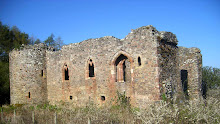
Rait Castle, a mile south of Nairn, is the best surviving example of a Scottish hall castle and yet in the last twenty years or more nothing has been done to protect this unique 800 year old structure. I took a walk up there yesterday. The owners have done a certain amount of shrub clearance, (I am told that more is planned) and with the foliage now at its thinnest you can get an idea of how the buildings within the protective barmkin wall might have looked when the castle was abandoned in the 15th century. But it is damage to the building itself that really concerns me: trees grow out of the wallheads, their roots boring into the handiwork of those who probably also built Barevan Kirk and some of Kinloss Abbey.


Some ten years ago I put up a site, provocatively titled Save Rait Castle. It is now a bit out of date but I hope you can see there why this castle is both historically important and architecturally impressive. There is also a good ghost story.


Why has nothing been done? It's a long story, centring round a protracted dispute over ownership which allows bureaucracy to look the other way pleading, "We can't do anything until we know the legal owner". Personally I think the law must be changed so that landowners are obliged to take responsibility for historically important buildings on their land and the state is obliged to intervene to get things done, imposing harsh penalties for non-cooperation.

Finally, and a little whimsically, Gervaise de Rait was Edward I of England's man in Nairnshire. When Edward was strutting his stuff as the self-appointed 'Overlord of Scotland' in 1303, he spent ten days at Lochindorb Castle. During this period his army famously took Urquhart Castle, but also Nairn Castle. Rait lies on the road from Lochindorb to Nairn and it would be strange indeed if he didn't dine, or sleep, or both with his adherent at Rait!

Thursday, January 29, 2009

Jerome S. Anderson (The First)

This was never meant to be a family history site but I was delighted, back in November 2007, to have united descendants of Jerome S Anderson who left the Isle of Skye for the New World in 1706. The descendants in the original post were living in Norway and France. I wrote then, "Who knows? There may be a whole lot more of you out there waiting to be linked up", and little suspected that this would unearth descendants in Waterford Connecticut, New Mexico, North Carolina and Schuylkill Pennsylvania!

Here now is a picture of the great man. Many thanks Suzanne Tedeschi.

Wednesday, January 28, 2009

Mullach Clach a'Bhlair

This post has nothing to do with clans and castles - I forsook the office and took to the hills today. This is what I saw.

Glen Feshie:
A little of the ancient Caledonian Pine Forest (and three generations of cocker spaniel):
Cadha na Coin Duibh:
Approaching the summit of Mullach Clach a'Bhlair:

Sunday, January 25, 2009

Barack Obama and Robert Burns

It's always irritating to be beaten to a good idea! With the newspapers today packed with the words of these two plain speaking, egalitarian-minded men (today is the 250th anniversary of Burns' birth), it seemed a good idea to link the two. Unfortunately Emma Cowing in the Scotsman got there first.

I have written already of how Abraham Lincoln used to carry a volume of Burns around with him. Indeed I wrote then that Burns' passion for social justice fuelled the US leader's crusade to emancipate African-Americans.

Has President Obama read any Burns? I suspect not, but I think he would enjoy it...


The Tree of Liberty (circa 1789)
Wi' plenty o' sic trees I trow,
The warld would live in peace, man;
The sword wad help to mak a plough ,
The din o' war wad cease, man.
Like brethren in a common cause,
We'd on each other smile, man;
And equal rights and equal laws,
Wad gladden every isle man.

I would like to trawl through President Obama’s Inaugural Address and other speeches looking for parallels but the haggis is smelling good and I am being called on to mash the neeps!
It looks like a good evening. Och Aye. And we’ll tak a right guid willy waught, for auld lang syne.

Happy Burns Night!

Wednesday, January 21, 2009

Britannia's Slaves

Most of us in Scotland watched yesterday's inauguration of the 44th President with a degree of excitement. The BBC commentators made the point several times that whilst President Obama's roots are in Kenya, his wife Michelle's ancestors were slaves.

The talk of slavery set me thinking for some reason about that great English anthem, 'Rule Britannia', (sung with great gusto each year at the Last Night of the Proms in London):
When Britain first, at Heaven's command
Arose from out the azure main;
This was the charter of the land,
And guardian angels sang this strain:
"Rule, Britannia! rule the waves:
"Britons never will be slaves."
Leaving aside the question of The Almighty's role in creating this island, it is interesting that these words, (by Lowland Scot James Thomson) were first heard in London in 1745. It was in the following year, after the Battle of Culloden, that thousands of clansmen (each one a British citizen) were sold into slavery in America. More would follow.

Mind you, this had already been going on for a hundred years or more:

On 28 July 1651, John Cotton, a Puritan Minister in Boston, wrote to Oliver Cromwell, "The Scots whom God delivered into your hands at Dunbarre and whereof sundry were sent hither, we have been desirous (as we could) to make their yoke easy. Such as were sick of the scurvey or other diseases have not wanted Physick and chyrugery. They have not been sold for slaves to perpetual servitude. But for 6 or 7 or 8 yeares as we do our own."

Note: The reference is to the Battle of Dunbar, September 1650.

Saturday, January 17, 2009

Dunnottar Castle

I have felt a great warmth towards Dunnottar Castle ever since, ten years ago, I wrote and published the official guidebook. The castle, however, has never reciprocated - mainly since it has no heating. And this is one of the concerns expressed by our Schools Minister, Maureen Watt who has called for the castle to be taken into state control .

Dunnottar, on a windswept clifftop south of Aberdeen, is about fifteen minutes walk from the road and there is no shop, no tea room, no electricity, and normally only one member of staff in the place. And yet this is one of the most significant of Scotland's castles - William Wallace, Mary Queen of Scots, the Marquis of Montrose, Charles II, they have all been here and added their stories to this extraordinary cluster of buildings. Dunnottar also saw the dramatic saving of Scotland's crown jewels, the oldest in the United Kingdom, from under the nose of Oliver Cromwell who hoped to destroy them.


The owners of the castle point out that visitor numbers are rising. But Dunnottar should be seeing 60,000 visitors per annum, not the present 40,000. More importantly, the visitor experience is not nearly as good as it could be. Government administration is not necessarily the answer: some of the most exciting visitor attractions in Scotland are privately owned castles - Glamis, Cawdor, Inveraray. But these have been in the family for 50o years or more; the last Keith Earl Marischal of Scotland left Dunnottar in 1651 and the castle fell to Dunecht Estates, the present owners, almost by accident in 1925.

At the moment Dunnottar is a convenient cash cow within a business whose main interests lie elsewhere. To be fair, much has been done in the last ten years - there is now an exhibition, there are benches and the rock doves have been denied access to at least some of the buildings. But this is not enough. Back in 2001 I researched the opportunities for grant funding to allow Dunnottar to become a modern, welcoming, visitor attraction. No doubt rules have changed but if government ministers are expresssing concern, then money will be found and if Dunecht Estates are not able to embrace such an initiative, then I hope Maureen Watt gets her way.

PS. The stunning shots in this post are by Jim Henderson whose photos also account for the great success of the castle guidebook.

Thursday, January 08, 2009

Aldourie Castle

Every good tour guide knows Aldourie Castle - it's the fanfare of towers and turrets seen across Loch Ness for about ten seconds before it disappears again. Apart from ruined Urquhart, Aldourie is the only castle on Loch Ness but for years tour guides have not known what to say about its present state: it was privately owned by Angus and Judy Cameron until 2002 and then sold to some Americans who did nothing with it.


I was there yesterday with three of my Scottish Clans and Castles colleagues and can report that Aldourie is now embarked on the most amazing rebirth. Furniture, fittings and thousands of books are all in store whilst the castle is gutted and reorganised as a dramatic 'exclusive use' venue. Quite unusually, the English owners are passionate about restoring the castle to recall its Victorian glory - the time when the Fraser Tytler family entertained with great style in their very fashionable Scottish Baronial castle, recently created from a traditional laird's house, built by the Dunbar family in the 17th century.

We stood on the battlements and looked at Loch Ness through diverging vistas of mature trees. We went through a lychgate to see the private graveyard in the woods. We admired the arboretum and three massive dilapidated greenhouses flanking an enormous kitchen garden. All of this is being restored.

There is no doubt that the revitalised Aldourie Castle will again see entertainment in great style. If you would like to book Aldourie for a family or business event, just let us know.

Friday, December 19, 2008

Jacobite Symbolism

I think the Jacobites could have done with a strategic marketing consultant. Brand confusion? Tell me about it!
WAY too many logos...

The white cockade, the white rose, rosebuds, blue bonnet, oak tree, acorns, oak sapling, star, thistle, birds, compasses, sunflower, moth, butterfly, JR VIII and 'Amen'.
Amen.

(Of course it is more difficult to get your marketing message across when you are a proscribed organisation.)

Did you know that ...?
  • 'Amen glasses' (right) are so called as they were inscribed with the Jacobite version of the National Anthem which ends, 'Amen'. 'Amen glasses' are on display at Traquair and at Culloden Battlefield.
  • Jacobites would toast the king at official dinners whilst passing their wine glass over water bowls to signify the Stuart king in exile, "over the water." This is why water bowls were banned at royal banquets until 1903.
And now a musical expert believes that "O Come All ye Faithful" is actually a Jacobite call to arms...

"Fideles is Faithful Catholic Jacobites. Bethlehem is a common Jacobite cipher for England, and Regem Angelorum is a well-known pun on Angelorum (angels) and Anglorum (English). So 'Come and Behold Him, Born the King of Angels' really means, 'Come and Behold Him, Born the King of the English' - Bonnie Prince Charlie!"

So if you raise a festive glass this Christmas or sing a much loved carol, beware of being tacitly treasonable. They're watching, you know.

Happy Christmas!

Saturday, December 13, 2008

A Bedrock of Scottish Civil Life dies after 313 Years

I wrote on Thursday about the attempted castration of Scotland by Edward I of England. Well, some here feel that a combination of greed and arrogance both in Scotland and in the USA have now more or less done the job. It happened yesterday in Birmingham where shareholders voted to approve the merger of the Bank of Scotland with Lloyds TSB.

Just three years after the Massacre of Glencoe subscription books, bound in red leather, were opened in Edinburgh and London. In time, 172 shareholders emerged and gathered together a working capital of some £100,000 sterling. The following year The Bank of Scotland was the first in Europe to issue paper currency; seen here is a twelve pound note dated 24 June 1723 .

When Prince Charles Edward took Edinburgh in the 1745 Rising, all the bank's papers and valuables were safely stored in Edinburgh Castle which never fell to the Jacobites. And in the 1800's when many other banks failed, the Bank of Scotland soldiered on. Until yesterday.

The history of the bank is given here and the page's title is
'Bank of Scotland (1695 - )'.

Well now they can fill that bit in!

Thursday, December 11, 2008

A Significant Escape

On this day, 11 December, in 1282 the last native prince of Wales, Llywelyn ap Gruffydd, was killed by Edward I of England's soldiers. Edward then announced that the new Prince of Wales would be "a prince born in Wales, who did not speak a word of Welsh" and produced his infant son, later Edward II, born at Caernavon Castle when his father was campaigning in the area.

And so it is that to this day the male heir to the British throne automatically becomes 'Prince of Wales'.


Which makes me ponder on the lucky escape we had in Scotland. Edward was good at castrating the countries that he aimed to control. After Wales he moved on to Scotland and removed the ceremonial Stone of Scone upon which Scottish kings were crowned. How fortunate we were to have William Wallace to lead the resistance to Edward's 'overlordship' until the English king was overcome by a surfeit of campaigning, and King Robert I to defeat Edward II in battle at Bannockburn (above).

R.I.P. Llywelyn ap Gruffydd.