Sunday, December 20, 2009

Nairn is one of the World's Top Five Travel Destinations for 2010!


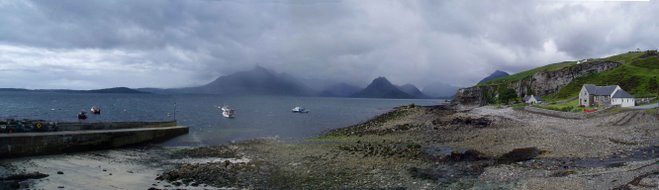
I am delighted, privileged even, to be writing from Nairn, one of the top five travel destinations in the world! And no, this is not as voted by the Association of Nairn Businesses but according to the all knowing Tripadvisor. In the days of Charlie Chaplin Nairn was known as the 'Riviera of the North'; it doesn't look quite like that today with five inches of snow on the ground, but this news will be heartening to Ian Bochel of Nairn's excellent Sunny Brae Hotel and Iain Fairweather who doughtily promotes Nairn via www.visitnairn.com and took the excellent photo above.

Disappointing that neither Fodor's nor Lonely Planet have warmed to Nairn's charms but they don't even put Scotland in their top ten so what the hell do they know! They'll catch on one day.

We all look forward to welcoming you to Nairn.

Wednesday, December 16, 2009

Cleits and Whisky Distilling in Achapharic


It's a lovely time of year.

Not just the frost (picture taken yesterday) and festive stuff, but those of us lucky enough to be running holiday companies have a few minutes to ponder: 2009 holidays are done and only a few people are embarked on next year's arrangements. Of course there is still plenty to do, but I allow myself to pursue the occasional 'red herring' . A Canadian client wrote:

'The reason for the Kintyre Peninsular is that my parents found our ancestors' place of residence (a ruin) on the west coast of the peninsular near A'Cleit on a visit a couple of years ago. We absolutely need to visit that place. It was called Achapharic)'.

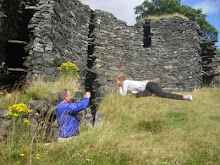
I learned that cleit is a word that survived largely on St Kilda (before it was evacuated in 1930), meaning a stone built storehouse and I came on this wonderful picture of a man on a cleit roof holding a fowling rope. The rope would be so that a youngster would have a safety rope as he raided the nests on cliff ledges below for plump young gulls. Another picture of a cleit below.

'Achapharic' took me to stories of illicit whisky distilling to make money that was needed for ever higher rents...

In 1806 a typical rent would be one or two 3-year old wedders at six shillings each, six dozen eggs and six hens valued at four shillings plus a sum of money which entitled the tenant to a seat in church. The tenants were also bound to cart loads of turf for dyking, grow oats and bear for meal, flax for coarse linen and give the services of a man and a cart free for two to six days annually.

Living off young gulls or keeping hold of your house only by distilling whisky in the hills and evading excisemen...

We've come a long way in 200 years.

Or have we?

Saturday, November 21, 2009

Fatlips and Gilnocky

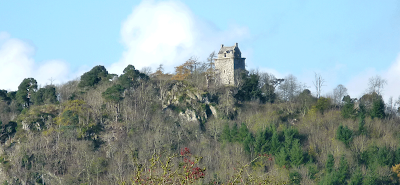
I was in the Borders on a glorious autumn weekend (just before the floods!). As we passed Fatlips Tower on Minto Crags, I gave the traditional explanation of the odd name: 'The Turnbulls had fat lips'. But apparently there is a more interesting theory: one of the pleasures of a visit to Fatlips used to be that "every gentleman, by indefeasible privilege, kisses one of the ladies on entering."


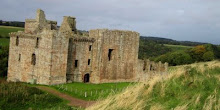
The Turnbulls were a small Border clan; but travelling south we passed Caerlanrig, a place of pilgrimage for the Armstrongs, a big beast in the Border reiving jungle. In the 1500s Border families were raiding into England, embarrassing the Kings of Scots and in November 1530 Johnnie Armstrong of Gilnocky, one of the most successful reivers of his day rode out to Caerlanrig. He was invited to meet his king. Dressed in his finery, and with promise of safe passage, he rode with thirty-six followers to meet the youthful James V of Scotland who was hunting in the area.

Well, in brief, Johnnie and his men were taken and hanged without trial - pour encourager les autres. Johnnie's grave is there. His exploits are commmemorated in The Ballad of Johnnie Armstrong.

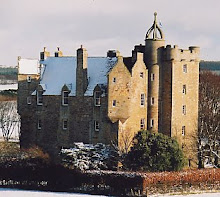
We went on to Johnnie's home at Gilnocky Tower (below), now a Clan Armstrong museum. (And yes, this photo was taken on 13 November 2009!).


As we headed further south, west and into England, we passed Carlisle, whose castle is made famous in another great story of the Borderlands. Kinmont Willie, also an Armstrong, was dramatically sprung from the castle by a bold Border raiding party led by Sir Walter Scott of Buccleuch.

But that... is another ballad.

Friday, October 30, 2009

The Highland Archive Centre

I had a tour today of the very new Highland Archive Centre in Inverness: four large temperature and humidity controlled rooms house a mass of maps, records, letters, books, some dating from the 15th century. This is now the official depository for most of the records in the Highlands, but there are also large leatherbound volumes recording deaths, wills and landholdings throughout Scotland together with 'Burke's Peerage' and records of Scottish landed gentry. Out of curiosity I looked up a distant aristocratic ancestor who was apparently notable for having been rowdy in a Lyon théatre in 1768: he refused to shut up and accepted the offer of a duel in the foyer where both men were apparently run through but neither died! Of more general interest perhaps is the Family History Centre, full of clan and family histories. Staff are on hand to help, and you can make an appointment with the Highland Council Genealogist. But note that the centre is not open at weekends.

Friday, October 23, 2009

Albannach and Cymry

I've had a fascinating couple of days at 'Scotland's Global Impact' Conference in Inverness. I expected to learn more about well... the words in the title, but I didn't really expect to be re-educated on the origin of well-kent words.

I always thought 'Alba' was a deep-rooted, chest-puffing term for ancient Scotland. I enjoy explaining to clients that Sassenach are Southerners and by contrast, Albannach are us - Scots, Highlanders, Celts. Not a bit of it! I learnt yesterday (from Dr James Fraser of the School of Celtic and Scottish Studies at Edinburgh University) that Alba actually means Britain, the whole island. Hence, I suppose, 'perfidious Albion', a well established epithet for England, perhaps due to the white (albus) cliffs of Dover. Viewed, as this island was, by Gaels from Ireland, I suppose this all makes sense.

I did actually know that 'Welsh' (also Walsh and Wallace) means foreigners. But I didn't know that "Wales" originates from the Germanic word Wahl which referred to foreigners who had been "Romanised".

Talking of Romanisation, James Fraser also explained that Britons in the South of Scotland (south of the Antonine Wall) were proud to be thought 'Romanised'. Even after the Romans had left. Some legacy!

In the tenth century 'Alba' came to mean the nation of Picts and Gaels. And in the afternoon we, too, moved into the Middle Ages. Masses of interesting thoughts and stories, but no etymological shocks.

Sunday, October 11, 2009

The Stone of the Maiden

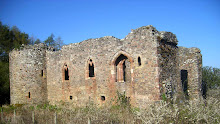
It has been a lovely bright autumn weekend and I took a walk to a local landmark called the 'Stone of the Maiden'. Lying in the dappled sunlight of a larch wood, this extraordinary rock, a mass of small stones bound together many millions of years ago, played a key role in Nairnshire's 16th century version of Romeo and Juliet. This was the stone where the lovers would meet prior to the tragic denouement, ultimately played out at Rait Castle.


The gist is that an attempt by the Comyns of Rait to murder their neighbours the MacKintoshes by inviting them to dinner at Rait was dramatically reversed, thanks to two young lovers. The story is told in full on my Save Rait Castle site.

Three questions remain in my mind...

1. How do you cut off both of a young girl's hands when she is hanging out of a window?
2. Why did the MacKintoshes leave the castle to become ruinous and not take it over when it was available to them in 1442?
3. Why do the Custodians of Scotland's architectural heritage continue to allow this, the best standing example of a 13th century Scottish Hall House, to be overtaken by the surrounding undergrowth?

Sunday, September 13, 2009

Cawdor Castle

Yesterday I spent a happy late afternoon in the Cawdor Castle gardens, trying out a new camera.

For many the word 'Cawdor' brings just a faint echo of 'Thane of Cawdor' in Shakespeare's 'Macbeth'. In fact Macbeth became king of Scotland in 1040; and so long before the castle was built (circa. 1400) or even the first Thane appointed (1295).


Cawdor has a golden thread of authenticity: built by the third Thane, it is now the winter home of the 25th Thane's widow. It is also a stylish survivor: despite the Battle of Culloden ten miles away and the Battle of Auldearn six miles away the castle is undamaged by battle or ill-advised additions and has grown in sympathy with the original architecture. Today the castle shows how history, art, fine gardens, gracious 21st century living and a successful visitor attraction may be happily combined.

And the golden thread is there for those who look. The thorn tree, over which the castle was built in 15th century, (whereby hangs a tale) is still there; radio carbon dating confirms it. The joining of the families of Cawdor and Campbell in the early 16th century is in the crest above the drawbridge: Campbell Motto, Cawdor crest. That's another tale - one of kidnap, mutilation, murder and a surprisingly happy marriage!

And above the main entrance is the coat of arms of Sir Hugh, 15th Thane. He married Henrietta Stewart whose arms, including the familiar red lion rampant, are on the right. Their 17th century marriage bed, recently reconditioned, is on display in the castle.

As I wandered round the gardens, I started to notice dates. An aromatic herb native to North America, collected in 1744. Lavender beds laid out by the Lady Cawdor of that time in 1850. The holly maze, planted in 1981. And one part of the Rose Garden is closed as it is currently being reconstructed. And so it continues. An age away from Lady MacBeth and her devilish plotting.

Wednesday, August 26, 2009

Release of Abdelbaset Ali Mohmed al-Megrahi

Scotland finds itself blinking in the spotlight of international attention. The land of tartan, whisky, clans and castles suddenly has a role on the world stage.

So how did this unusual situation come about?

Well, it all goes back to the Union of Scotland and England to form a United Kingdom in 1707. Scotland was very much the weaker party and was out-negotiated on the all the important issues such as trade, tax and political representation. We did however hold on to institutions that were important to us: our own education system, our own established church and our own legal system.

Until Prime Minister Tony Blair gave Scotland its own parliament and a degree of devolution, justice here was in the hands of the Secretary of State for Scotland, a member of the UK Government. But since 1999 we have elected our own Scottish administration to deal with health, education, prisons, environment ... and justice.

'And so', I am asked, 'is all this going to affect tourism?'
Well I really cannot imagine so. I fully understand the strong feelings expressed, but this release does not reflect any groundswell of pro-Libyan opinion in Scotland. Far from it. This is one man's decision, flowing from a long established and compassionate legal system. Right or wrong, it is now a fait accompli and the Scottish Government is unlikely to have a similar decision to take in the next 500 years.

In my view the big loser in all of this is Libya: that country has missed a unique opportunity to raise its standing in the world by demonstrating dignity, gratitude and respect for the dead.

Saturday, August 22, 2009

Château de Grimaud

We had just under two hundred people in Edinburgh during The Gathering - a busy time for our small company. And once everyone was safely back home, I took a few welcome days off in the South of France. Castles continued to call though, and I climbed up to the Château de Grimaud, dramatically overlooking the Gulf of St Tropez. I had thought it was a Saracen fortress, but it was actually built by the king's grand sénéchal, Jean de Cossa in the 15th century. Essentially a medieval castle, it has massive towers with firing slits and high walls surrounded by a long stretch of crenelated ramparts up to seven metres high. In 1791 the French Revolutionaries confiscated and then demolished this aristocrat’s residence and it has been a noble ruin ever since. There are great views but the lack of maintenance and any interpretation made me realise what an excellent job Historic Scotland do for us and our visitors.


But the charm of Grimaud village with its colourful alleyways and a game of boules in the shade of the plane trees is something we may struggle to match!

Wednesday, August 05, 2009

A Funeral by Loch Ness

The redcoats stopped when they saw the funeral. A troop of six was escorting the bread wagon to Inverness and any gathering of Highlanders was worth a look in 1746 - there might be a wanted man, an illegal weapon. If nothing else, there was no harm in emphasising who controlled the food supplies, controlled the Highlands, following the Battle of Culloden earlier that year.

The ragged group around the coffin huddled closer, guarding what dignity remained to them. The priest looked up, paused and continued. Dismounted troopers were moving round for a better view. As they did so, an old woman swept a loaf of bread from the back of the cart into her dark shawl. Someone shouted. The woman ran. Troopers cocked their weapons. The funeral party dived behind gravestones. A shot rang out. Then another. Someone was hit…

It wasn’t a major incident in that incident-rich year. But it left its mark. Three marks in fact – the pits made by bullets on the gravestone of a James Fraser, buried in 1730.

It is not easy to bring the past to life, but last week my Outlander Tourists (fans of Diana Gabaldon’s Outlander books) were able to touch some little marks of conflict, unchanged, unrepaired, largely unnoticed since that fateful year of suppression.

Saturday, July 18, 2009

Basking at Inverness Highland Games

There was a distinctly Basque feel to this year's Inverness Highland Games. Guests Nazioen Mundua supplied music, dance, strongmen, wood choppers and a yoaldunak band - who play their instruments with their bums (actually just one instrument and just one note but impressively loud). This unmissable display punctuated my personal highlight of the games, a quiet (well it was meant to be quiet) drink with best selling author Diana Gabaldon who was doing a book signing in the clan village.

Diana's novels must have brought thousands of extra tourists to Scotland, exploring the romance of 18th century Highland living, hoping perhaps to meet her dashing, scholarly, gentlemanly (and above all sexy) hero, Jamie Fraser.
I have been running guided tours for fans of the novels for several years now and it was an enormous pleasure to meet the softly spoken, highly engaging, creator of the series - so interested in this distant world where she is a celebrity guest. I'm looking forward to continuing our conversations, without the unforgettable accompaniement of the yoaldunak.

Incidentally if you would like to see the yoaldunak being performed in a Basque village, rather than the Clan Village, click here (and wait a minute or so for it to load).

Sunday, July 12, 2009

An Edinburgh citizen with a gift for words.

A leather-bound volume offers this overview of Edinburgh...

"For centuries it was a capital thatched with heather, and more than once, in the evil days of English invasion, it has gone up in flame to heaven, a beacon to ships at sea. It was the jousting-ground of jealous nobles, not only on Greenside, or by the King's Stables, where set tournaments were fought to the sound of trumpets and under the authority of royal presence, but in every alley where there was room to cross swords, and in the main street, where popular tumult under the Blue Blanket alternated with the brawls of outlandish clansmen and retainers."

And of its citizens...

"To see them thronging by, in their neat clothes and conscious moral rectitude, and with a little air of possession that verges on the absurd, is not the least striking feature of the place."

The author was Robert Louis Stevenson (1850 - 1894) whose book, simply titled 'Edinburgh' should, in my view, be compulsory reading for every Edinburgh tour guide - and for any would-be wordsmiths tempted to write a guidebook on our capital city.

Wednesday, July 08, 2009

One Old Jacobite and formal terraced gardens

One of my heroes is George Keith, the last Earl Marischal of Scotland. Born into one of the great offices of state, with extensive lands round Dunnottar Castle, he had a good life in store. But in 1715, aged 23, he risked it all by declaring for the Jacobites. He commanded the right wing cavalry at Sherrifmuir - an extraordinary battle in which the right wings of both armies routed the other side; the Jacobites had the superior numbers but, under the bumbling leadership of the Earl of Mar, failed to hold the ground and the government forces took the day. Along with other dispirited Jacobite leaders, Keith retired that night to nearby Drummond Castle, home of the Duke of Perth.

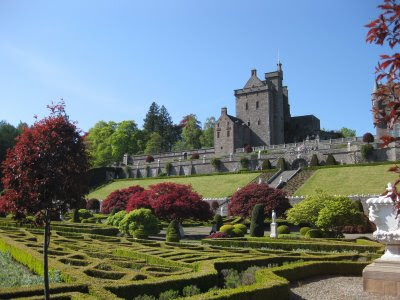
I was there two weeks ago. Looking out on the fine formal terraced gardens it was hard to imagine the despair of brave men contemplating defeat, attainder, life-long exile, the loss of everything that they couldn't carry with them.

George Keith went on to have a long and varied life. He returned to Scotland from Spain as leader of the 1719 Jacobite rising and later was a roving ambassador for his exiled king. His travels took him to the court of Empress Catherine II of Russia and when that court was purged of foreigners he went to Prussia, eventually becoming Frederick the Great's ambassador to Paris. Here, in 1745, he tried hard (with the benefit of bitter experience) to dissuade Prince Charles Edward from making an attempt at the throne without foreign help.


He retired to a life of intellectual debate and the tending of plants at Frederick's Potsdam Palace, Sans Souci (above). In his eighties he was still writing energetically to friends in Scotland. Ultimately, it seems, he was far more at home amongst the sophistication (and yes, the formal terraced gardens) of Sans Souci than he was in the wave-lashed fortress of Dunnottar Castle which would otherwise have been his inheritance.


Tuesday, June 16, 2009

Hats off to Clans & Castles!

Just arrived...

"We just completed an extraordinary 10-day family vacation in Scotland based on a customized itinerary developed with the expert services of Scottish Clans & Castles. The trip was a mix of city and country with a terrific blend of classic and modern hotels, as well as two top-notch B&B’s, namely Brough House (Elgin) and Ethie Castle (Arbroath). The arrangements were flawless, the accommodations perfect and it appeared to us that they were able to secure the rooms with the best views, every single time. To us, this was an unexpected benefit of dealing with a local expert and a reflection of the intimate knowledge of their recommendations. Dealing with Alastair and his team in planning this memorable trip was a wonderful experience and we are looking forward to returning, hopefully sooner than later. Hats off to Clans & Castles!"

I hate self congratulatory blogs! But the above is a nice (unedited) word of appreciation. Now and again it is good to wave a flag. We are in business after all!

We enjoyed looking after the VanderPlaat family from Canada since we had a clear brief which included accommodating the requirements of two children, seeing round the privately-owned Dunderave Castle (above) and also visiting the Perthshire estate from which Jane VanderPlaat's family had emigrated three generations ago. It all seemed to work very well.

Many thanks to all our excellent hotels and B&Bs.

Friday, June 12, 2009

Dunollie Castle. In need of a Little TLC.

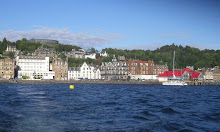
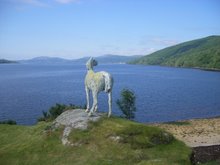
Camouflaged in the intense green scenery of Oban Bay is Dunollie Castle, seat of the MacDougalls, senior branch of the sons of Somerled, but one that opposed Robert the Bruce and suffered grievously for it. I was in Oban on Tuesday for a meeting of Scotland's Tourism Innovation Group; and as you can see, the weather was sensational.

They lost a lot, but the MacDougalls kept hold of Dunollie and the island of Kerrera from which this photo was taken; they also kept hold of the Brooch of Lorne, famously snatched from King Robert at Dalrigh, and still in the possession of the clan.

Dunollie, a place of pilgrimage for the clan, is badly in need of restoration. And the Brooch of Lorne, a clan icon for 700 years, is playing its part in raising funds as the talisman of a play 'The Hidden Jewel' to be performed at the castle 17 to 23 July 2009. Tickets and more detail here.

Another MacDougall initiative is the Hope MacDougall Collection, a remarkable collection of artefacts reflecting domestic and working life in the Highlands and Islands over the past 200 years. A selection is currently on display in a shop on George Street. More here.

Dunollie badly needs help; and happily the MacDougalls have some impressive form in the field of restoring castles. In May 2006 remote Gylen Castle (below), on the southern tip of Kerrera and ruinous since 1647, was opened to the public. Let's hope they can pull it off again.

It was alsoat Gylen that the Brooch of Lorne was stolen by the Campbells of Lochawe. But that is another story...

Sunday, June 07, 2009

The Gathering of the Clans


In seven weeks time The Gathering of the Clans 2009 will be over: the first such event since George IV visited Edinburgh in 1822 - and set the kilt on its road to recovery after its banning following Culloden. In seven weeks the last caber will have been tossed, the last piobaireachd played; the March up the Royal Mile and the Clan Pageant at Edinburgh Castle will be a mass of colourful and inspiring photographs dominating the Sunday newspapers and, in due course, Scottish magazines worldwide.

You can still be there if you would like! Just drop us a line and we'll fix it for you.