Monday, July 19, 2010

Glenkindie Arms Hotel


I don't normally highlight particular hotels or inns in this blog. We have about 700 on our database and they all have their particular strengths. But last weekend I stayed at a most remarkable place in Upper Donside, Aberdeenshire. Two years ago the four hundred year old Glenkindie Inn was a rundown pub, probably destined to become a private house or worse, a second home, but certainly nothing that would draw people into the area.

Enter Ian Simpson, an entrepreneurial chef from England, looking to start his old business. The bar is now a smart little restaurant, the rooms up above are comfortable if not luxurious.

The menu options are on the blackboard and my three course dinner was delicious, beautifully served, fully justifying the inn's newly acquired two AA rosettes.

For breakfast I went for honeyed apricots and yoghurt followed by scrambled eggs, mushrooms and bacon.  I was invited to choose my own local free range eggs, the mushrooms were actually locally gathered chanterelles and the toast came with home made jam.  Dinner bed and breakfast cost less than GBP 65.

We need more Ian Simpsons. Good luck to him.

Thursday, July 08, 2010

If The Queen is to be present in your building, please contact the Protocol Team,

People sometimes ask what is the difference between the Saltire (blue and white cross) and the Royal Banner (red lion rampant) and don't seem to believe it when I say that the Royal Banner should only be flown when The King (or Queen) of Scots is present!


Well, here is the official protocol, taken from the Scottish Government website:

The Royal Banner is The Queen’s official banner in Scotland. Flags showing the Banner of the Royal Arms of Scotland (the ‘Lion Rampant’) or the Royal Arms as used in Scotland (the Quartered Arms) are Ensigns of Public Authority, and are therefore only used by The Sovereign or Her Great Officers, such as Lord Lieutenants, when acting in that capacity.

The Royal Banner is usually only hoisted above a Scottish Government building during the period The Queen is present in the building. It is not hoisted when The Queen is only passing in procession. If The Queen is to be present in your building, please contact the Protocol Team, Constitution Directorate, DG Constitution and Corporate Change to make the necessary arrangements.

The flying of the Royal Banner from a non-Government property or garden is not permissible, as it implies that the flag flyer is claiming the Royal Arms as his or her own.

Tuesday, July 06, 2010

The Munros of Novar

On a hill overlooking the Cromarty Firth is a striking, most un-highland monument. I guess that travellers must have been wondering what on earth it is ever since its erection in 1782. In fact it is a replica of the gates of Negapatam in South East India - originally a Dutch colony, won by the British in 1781.


Responsible for this success was Sir Hector Munro, 8th of Novar (1726 - 1805) who won fame and fortune as a British Army Officer in India. When he retired to Scotland the following year he found that in the midst of the Highland Clearances many Munros and others in the area were unemployed and hungry, so he paid them all to carry stones to the top of Cnoc Fyrish where the monument to celebrate his triumph was erected.

Tragically, Sir Hector's two sons were both killed in India, one by a tiger and one by a shark in the Bay of Bengal and the estate passed to his daughter whose descendants still own it.

And, until yesterday, that was all I knew of the Munros of Novar.


I now learn that Sir Hector's nephew, Hugh Anderson Johnstone Munro of Novar was one of the most notable art collectors of his day and a close friend of the English artist J. M. W. Turner. Munro eventually owned fifteen oil paintings by Turner and one hundred and nine of his water colours. One of his favourites, 'Modern Rome - Campo Vaccino' was sold by Munro's heirs in 1878 to the Earl of Roseberry for the astonishing price (at that time) of 4,450 guineas. It comes under the hammer for the second time tomorrow in a Sotheby's sale in London with an estimate of £12-18 million.

A blow, though, for the National Gallery of Scotland, to whom it has been on loan since 1978.

Tuesday, June 08, 2010

The Hanging of Neil MacLeod.

Yesterday, as part of the Nairn Book and Arts Festival, I was asked to introduce Alistair Moffat, author of  'Highland Clans'. Alistair has written a range of books, largely on Scottish history; and until last month I had read none of them.

I was intrigued by 'Highland Clans' - many of the points he makes, many of the anecdotes that he highlights, are those that I use on my own tours. But one extraordinary anecdote was new to me....

In 1597 the Edinburgh Parliament passed an act to enable the foundation of three new towns in the Highlands. One of these was to be on the Isle of Lewis, traditional land of the MacLeod clan. The name given to the company formed to establish the town on Lewis speaks volumes: "The Gentlemen Adventurers for the Conquering of the Isles of Lewis". Like those who were colonising the east coast of North America, they dug a ditch around their settlement and built a stockade. And, just as in Virginia, the indigenous inhabitants took exception. In 1601 the Adventurers retreated but legally they were still owners of  the island and they sold it to the Mackenzies who established themselves with 700 men. Neil MacLeod, chief of the clan, resisted, was arrested and eventually stood on a gallows in Edinburgh's Royal Mile.

MacLeod, a Gaelic speaker, did not understand anything that was said to him - until the hangman referred to him as bhodach, 'old man'. He knew that word and took exception, headbutting the younger man; and the crowd bayed for the blood of this savage. They got their blood of course. And the idea of Highlanders as savages continued until and beyond the Battle of Culloden in 1746 when this view of an alien people, was encouraged by government generals whose men had several times fled in the face of the Highland Charge (but stood firm on that day).

For centuries Scotland was divided. In the north, a nation of subsistence farmers spoke Gaelic, wore tartan, played bagpipes and recognised no authority beyond their clan chief. The other nation (which controlled affairs) did none of the above and they despised, feared and hated their northern neighbours.


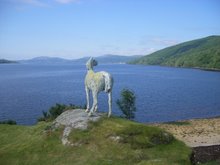
This has led to many problems and complications. The least of which, perhaps, is whether Lewis is MacLeod clan territory or rightly belongs to the Mackenzies whose traditional clan chief took his name from Loch Seaforth on Lewis (above).

Wednesday, June 02, 2010

The Teaghlach Wood

I visited the Teaghlach Wood at the weekend and met Angus Crabbie (below) who heads up Trees4Scotland.


Teaghlach, pronounced 'Chowlach' means family or household and it was launched, appropriately, at the time of The Gathering 2009 with donations from those attending to provide a lasting (and living) legacy of the occasion. It is still growing (in both senses of the word) and will continue to do so as part of Trees4Scotland's plan to expand Scottish woodland. This expansion is in part funded by those who wish to offset their carbon emissions through a project in Scotland and shortly we will be launching our own project to plant a tree for every booking that we take - and encouraging others to join us.

More on that later, but meantime it was great to see this enterprising project underway in the Perthshire countryside. Red kites were circling overhead, sand martins swooping around us and primroses huddled on the banks of the burn.

And once the trees grow... there will be even more wildlife.

Perhaps, with your help, it will one day rival the wonderful Carrifran Wildwood.

Friday, May 21, 2010

The Termit Stone

Two Mackintoshes from Pennsylvania were here last weekend searching for their roots. The Mackintoshes were traditional leaders of Clan Chattan (pronounced 'hatton') a confederacy of small clans, based south of Inverness.

Whilst doing a little research for the trip I came upon the signing of the 'Clan Chattan Band of Union' at Termit in 1609, and the stone laid to commemorate this event in 2009.

Termit? Try it in in Google and it suggests you mean 'termite'. Look on the map and it isn't there!
Well, now I can reveal to anyone who is interested that Termit (no buildings remaining) is about five miles east of Inverness on land now known as Moraystoun. The stone is accessible at Grid 753488 and, as you can see, it is looking well in the landscape.

Amongst the constituent Clan Chattan clans are: Mackintosh, Shaw, MacLean of Dochgarroch, MacGillivray, MacQueen, MacPherson, Davidson, MacBean, MacThomas, MacPhail, Cattanach, Ritchie, MacCombie and Farquharson.


So why did these smaller clans feel the need to band together? The official explanation in the Clan Chattan newsletter is here. More generally, I would suggest that since James VI, King of Scots, had recently accepted the throne of England, royal control of the Highlands was increasingly arm's length. The Gordons, the Frasers, the Camerons and the MacDonalds were all big beasts in the north. The smaller clans had to come together, or risk being eaten up.

Clan Chattan led the Highland Charge at Culloden in 1746.

Friday, April 30, 2010

Étienne Jacques Joseph Alexandre Macdonald, Maréchal d'Empire, Duc de Tarente.

At Howbeg on South Uist today there was a ceremony to mark the unveiling of a plaque to the memory of one of Napoleon Bonaparte's most distinguished generals: Marshall MacDonald.

(I am obliged to Uist Lady for the picture).


 The Maréchal's father Neil MacEachen was born on South Uist. A studious young man, MacEachan went off to the Scots College in Paris to study for the priesthood. He returned to find the 1745 Rising in full swing. It seems that he fought at Culloden; what is certain is that he was on that boat which carried 'Bonnie Prince Charlie' over the sea to Skye. MacEachen then stayed with the prince as escort/servant, until they eventually reached France and he had to make his own way in an unfamiliar world. Probably because no one could pronounce his name, he changed it to MacDonald and he joined a community of exiled and impoverished Jacobites at Sancerre. Later the family came along.

Little could poor Neil, whose wife took in washing and did cleaning jobs, have imagined what would happen 34 years later. In 1799: the new French Republic's wars against Britain, Russia and the Austrian Empire were not going well. A faction decided to mount a coup d'état and they needed a general to head it. According to author Jean Didier Hache who has written a book on MacDonald, the first choice general died in Italy, the second choice refused and the third choice was
MacDonald.

MacDonald refused. Napoleon Bonaparte willingly accepted!

In 1825 MacDonald returned to Uist to see his father's birthplace, but having no Gaelic and very little English, the visit did not forge much in the way of ties with the island. He did however return with some good Scottish earth which was buried with him on his death fifteen years later.

We often boast of enlightened18th century  Scots who were world leaders in science, medecine, philosophy. It would have been quite nice to have had an Emperor too!

Saturday, April 24, 2010

1776 and 1746

Home yesterday after a great trip to the USA but, due to volcanic ash, eight days later than scheduled. My distraction as I travelled (and waited) was a book from a second-hand bookshop in Kennett Square, Pennsylvania: '1776' by David McCullough, a remarkable account of the tough campaigning of that year - first steps on the road to a United States of America.

I'm sure numerous people have made the connection between George Washington's brave but ill-equipped army and that of Prince Charles Edward who had faced the same enemy thirty years earlier in an attempt to recover the throne for the Stuarts. Both armies were short of money, food, equipment, gunpowder, cavalry, artillery, just about everything. Both leaders appealed to the hearts and loyalty of their soldiers, both suffered from desertion by those who felt they should be tending their crops. The main difference, of course, was in the generalship: Washington may occasionally have been indecisive but, unlike Bonnie Prince Charlie, he was a natural leader who was prepared to listen to advice.

Washington, who struggled to keep the Yankees, the New Englanders and the Virginians together, would have been appalled at the three day horror which was Gettysburg. I spent a fascinating day there and was struck by the statistic that total casualties at Gettysburg were more than three times larger than the total combatants at Culloden.

Returning to Newark we crossed the Delaware at Trenton, where a brilliant Christmas Eve night manoeuvre by Washington changed the course of the war. Charlie's last-throw night march on the eve of Culloden similarly expected to find the enemy drunk. But the Highland Army arrived when the porridge was already on the boil, and they returned to camp exhausted.

When I am next at Culloden I will be much better able to answer questions from American visitors who are looking for familiar yardsticks for the history they are learning in Scotland.

Monday, April 12, 2010

Vatted Whiskies of the 19th and 21st Centuries

I have written before about Usher's Old Vatted Glenlivet - and proudly so, since Andrew Usher after whom it is named, happens to be my Great Grandfather. I explained then that the much used phrase 'single malt' is relatively meaningless nowadays since the days of vatted malts (a blend of malt whiskies) are long gone. Vatted malts were a great idea in the 19th century when independent (and recently legalised) distilleries across the Highlands produced wildly different products - some light and fiery, others heavy, peaty and a bit like cough mixture. Andrew Usher (amongst others) combined these different whiskies to produce a drink that was acceptable to the southern market. Nowadays malt whiskies differ, but all are more than palatable in their own right.


And so it was with some surprise that I found at 'Whisky Live' (part of Scotland Week in New York) last week nothing less than a new range of vatted malts. They are produced by the Compass Box Whisky Company of Edinburgh. I had a taste of their 'Spice Tree' which was excellent. I am also intrigued by Lady Luck (pity it costs £125!). This type of blending is very sophisticated and a great addition to the whisky story. Good luck to them!

As an addendum, the Scottish whisky blenders  - Andrew Usher, John Dewar, Arthur Bell, Johnnie Walker and others - really made their fortune as a result of the Great French Wine Blight. In the mid nineteenth century on verandahs throughout the world (and certainly in the USA) gentlemen were accustomed to drinking a brandy and soda before dinner. When the blight meant no french brandy a vast new market opened up for the whisky blenders from Scotland.

Aye, it's an ill wind...

Thursday, March 11, 2010

Why did Charlie want to go to Skye anyway?


Speed, bonnie boat, like a bird on the wing,
Onward! the sailors cry;
Carry the lad that's born to be King
Over the sea to Skye.

There are two big clans on Skye - the MacDonalds and the MacLeods. When guiding out there I'm oddly reluctant to reveal that neither one supported the Jacobites in 1745, indeed that both chiefs signed up to support the government. Bonnie Prince Charlie arrived on Skye on 29 June 1746, disguised as Flora MacDonald's maid, piloted by Donald MacLeod of Galtrigal. One of the men tasked to search for him was the 22nd Chief of Clan MacLeod; another was Lieut. Alexander MacLeod of Talisker who commanded the local militia (and dined with Flora at Monkstadt on the night she arrived on Skye!).

So why on earth did Charlie want to come to Skye? In short, government troops were closing in on him too fast on South Uist...where one of those meant to be searching for him was Flora's stepfather, Hugh MacDonald of Armadale, who was actually in on the plot to save him! It's complicated. Although the chiefs, and perhaps most men, were prepared to put their backs into finding Charlie (hoping to claim the reward of 30,000 guineas if they succeeded), there were enough loyal individuals to ensure his safety.


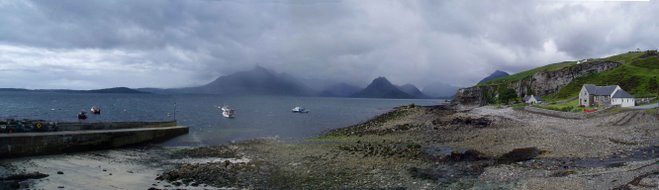
We've been talking about this is in the office because our Clan Tour  will visit Dunvegan Castle (top picture) seat of the MacLeods. Our clients will, ironically, be able to look over to Galtrigal (above), the home of the Prince's pilot, and see Jacobite relics such as Flora MacDonald's stays, her pin cushion, Bonnie Prince Charlie's waistcoat and a lock of his hair. Why is all this at Dunvegan? Well, it's because Flora left her Jacobite relics to her daughter who married the tutor to the next Chief of Clan MacLeod...

You see. Like everything to do with the Jacobites, it's complicated! But Pauline, our wonderful Clan Tour guide, will make it all seem quite simple!

Saturday, March 06, 2010

MacThomas Clan and the Tax Gatherers

I have been doing a little research on The MacThomas Clan. It's a sad (but not uncommon) story of a clan so rooted in their lands that they ignored what was going on in distant places such as Edinburgh. They were successful cattlemen at the start of the 17th century but they had their enemies, and in 1676 the MacThomas lands in Glenshee were sold as a result of law suits and fines for not paying fines.

The MacThomases who also briefly owned Forter estate in Glenisla (including its then ruined castle) dispersed throughout Scotland and the traditional lands were abandoned. However the present chief, Andrew MacThomas of Finegand is, unlike his ancestors, at home in the world of money and was a successful banker. He has recently presided over the purchase for the MacThomas Society of their traditional Gathering Place, Clach na Coileach or 'Cockstane (above); and the new bridge at the Spittal of Glenshee has been named after the clan. Finegand (as he should be addressed) has also written a history of the clan which was launched at The Gathering in Edinburgh last year.

And if you wonder where 'Finegand' comes from, it is a corruption of the Gaelic feith nan ceann, meaning burn of the heads. It seems that the Earl of Atholl sent some particularly officious tax gatherers across to Glenshee and the MacThomases took exception to this. They used their dirks and tossed the taxmen's heads into a nearby burn. Perhaps that is what is being conveyed by the clan crest.

Would that it were that easy to deal with officious officialdom nowadays!

Thursday, February 25, 2010

The Braemar Gathering

'Always the first Saturday in September'. The Braemar Gathering is one of the constants of Highland Life. It was reputedly started by King Malcolm III (who replaced MacBeth as King of Scots in the 11th century), but the first modern day games was held in 1832.

'Gatherings' or Highland Games were arranged by clan chiefs to display the prowess of their fast runners, strong men, pipers and dancers. It was also a good way of distracting their attention from moonlit raids on neighbouring clans' cattle. Clan Gatherings were banned by the government in 1746 following Bonnie Prince Charlie's 1745 Rising. But less than 100 years later Queen Victoria graced the Braemar Gathering with her presence - and Royalty have been attending ever since.

I was asked today why our Small Group Clan Tour was taking place in September. The answer is simple: we would like our clients to enjoy the Braemar Gathering - unique, royal and ancient.

Thursday, February 11, 2010

Redcastle or Killearnan

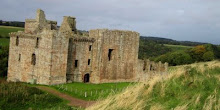
Went to an excellent lecture (one of the HOSTGA series of winter lectures) about Recastle on the Black Isle. This tiny community boasts one of the largest saltwater crannogs, a quarry that provided the stone both for Cromwell's Citadel in Inverness and the Caledonian Canal, and the most wonderful eponymous castle. Redcastle was built as a 9th century wooden fort to hold the line against the Vikings, owned by the monarch, rebuilt as a 16th century Mackenzie L-Plan tower house, burnt by Cromwell, rebuilt as a grand lodging in the early 19th century, enhanced with the proceeds of slavery, became a fine Edwardian country house with extensive gardens (below), was used as a bomb store in the second war and is now a dangerous ruin.

But the most memorable story told by Graham Clark, author of a fine book on Redcastle was about Kenneth Mackenzie, 8th of Redcastle. He was married at nineteen, an officer at twenty, fought in the American War of Independence, was captured, repatriated, court martialled for outrageous behaviour, formed his own company of 100 men, was sent to the Gold Coast where he tied one of his officers to a post and executed him with a nine pound cannon; he also commandeered a couple of merchant ships (which together would have paid off ALL his debts), but was instead thrown into Newgate prison on charges of murder and piracy. He was granted a Royal Pardon but killed a fellow officer in Edinburgh and disappeared to join the Russian Army; he became Vice Consul at Constantinople, got involved in yet another brawl, duelled at dawn and was shot dead. He was 41.

Wednesday, February 03, 2010

How Narrow is the Irish Sea!

Travelling round Ireland, I expected the stud farms but was amazed by all the golf courses. I'm glad we introduced the Irish to golf, since it seems that a worrying amount of Scottish culture first crossed the Irish Sea!


We went first to the Hill of Tara, home of Niall of the Nine Hostages, High King of Ireland and eponymous ancestor of the O'Neill dynasty (and St Columba). Why he had nine hostages is a long story but I now understand better why the MacNeills, MacLachlans and others so proudly claim descent from him.

We then saw the High Cross at Kells (small town made famous by the eponymous Book). High crosses at Iona are more impressive.


But I couldn't fail to be impressed by the neolithic ceremonial site at Brú na Bóinne. It's similar in many ways to the later Clava Cairns near Inverness but the ambition in Ireland was greater and more lasting: the extraordinary 20 foot high chamber, built without mortar, has lasted for 5,000 years. The smaller chamber at Clava was unfortunately broken into in the 19th century.

Last stop was the Fort at Navan, sacred place of the Kings of Ulster and the Red Branch Knights, of whom Cu Chulainn is the best known. Cu Chulainn learned the arts of war from Queen Sgathach and became the lover of her sister Aoife; he then went on to save Ulster from Eire and Skye from 'The Small Dark Men'. Sgathach's name lives on at Dunscaith Castle on the west coast of Skye, a favourite walk of mine.

Sunday, January 31, 2010

The Book of Kells

I am in Dublin, courtesy of Lynchpin Tours an Irish tour operator with whom we have worked for some years, providing an integrated experience for those wishing to visit our two countries. We flew from Inverness to Belfast and were met by David of Lynchpin who whisked us down to Dublin under pure blue skies. The same skies had allowed a great aerial view of the west coast of Scotland, the islands and the Antrim coast. Now 'divided' by sea, this was all at one time the Lordship of the Isles, controlled by the great Clan Donald and connected by these busy sea lanes.


We went straight to Trinity College Dublin and were met by Anne Marie Diffley, curator of the university library which now houses the Book of Kells, which in short contains the four gospels written on calf vellum by monks at the monastery of Iona in the 8th century. So far so remarkable that such a document should have survived, given time and the constant raiding of Iona by Vikings in the 8th and 9th centuries. (The golden case that housed the Book of Kells was actually stolen but the book discarded). What is truly remarkable is that on this tiny remote island, there were artists of such extraordinary genius since the book is illustrated extravagantly and exquisitely with images, symbols and Celtic knotwork created in pigments that had found their way from present day Afghanistan and Egypt to Iona.

No photograph can do justice to this incredible work of art; you have to see it.

When I asked when the book would return home to Scotland I was met with a wry Irish smile.

Saturday, January 02, 2010

Death of Sir William Wallace

In London for New Year, I came upon a Place of Execution: Smithfield, a little north of St Paul's Cathedral. Sir William Wallace is the most famous victim; well, he is the only one for whom there is a memorial plaque. On the pavement below lay a faded sprig of heather and small bouquets, tied with tartan ribbon. The romance of Wallace, guerilla leader, born four hundred miles away in another country, executed 1305, is enduring.


Smithfield, sandwiched between St Bartholomew's Hospital (founded 1123) and Smithfield meatmarket (slightly older) has seen numerous executions. More than 200 Protestant martyrs were burnt at the stake in the reign of Queen Mary, swindlers and coin forgers were boiled in oil there and Sir John Oldcastle, the original Falstaff was roasted alive in chains. But the only plaque is that to Sir William Wallace.

Only a few feet away is the lovely Church of St Bartholomew the Great. It has been in continuous use as a place of worship since 1143, is adjacent to the oldest inhabited house in London and has featured in such films as 'Shakespeare in Love' and 'Four Weddings and a Funeral'.

There is an odd connection here. Wallace was executed on the Eve of St Bartholomew's Day 1305. The Bartholomew Fair at Smithfield seems to have been a great party. Was Wallace's Execution the day preceding perhaps a curtain raiser to the celebrations? This might have appealed to Edward Longshanks.

PS. In Scotland we have a wonderful monument to Sir William near the site of his most famous victory; it's a pity that other significant places in his life are not well cared for.