Thursday, October 13, 2011

Queen Victoria's Love of Scotland

I've been working a few weekends recently and, now that the season is over, today I took a day off - a walk down the lovely River Findhorn...

... and a cup of tea at nearby Logie Steading, where there is a particularly good second hand bookshop. I fell prey to a book on Scottish surnames, a volume of Nigel Tranter's Fortified Houses of Scotland, and the book that has kept me engrossed for the past several hours, Ronald W Clark's Balmoral. No wonder Queen Victoria fell in love with Scotland when she visited first in 1842!

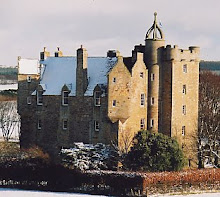
At Dunkeld the Royal Party was met by the Atholl Highlanders, armed with the Lochaber axe. Received in an immense marquee, they were regaled with a gargantuan menu, a display of Highland sword-dancing and a taste of Atholl Brose. Taymouth Castle took things to a higher level.   The firing of the guns," Victoria recorded in her Journal, "the cheering of the great crowd, the picturesqueness of the dresses, the beauty of the surrounding country, with its rich background of wooded hills, altogether formed one of the finest scenes imaginable. Lord and Lady Breadalbane took us upstairs, the hall and stairs being lined with Highlanders". If anything more were needed, dusk brought not only fireworks but 'Welcome Victoria - Albert' spelled out in hundreds of oil lamps, and the blaze of bonfires from a dozen nearby summits" .


Taymouth Castle
Following the Battle of Culloden in 1746, Queen Victoria's great great grandfather George II had done everything in his power to destroy Highland culture (an undoubted seedbed of Jacobite discontent and a threat to the throne since 1689): the wearing of tartan was banned, the carrying of weapons was banned, the playing of the bagpipes was banned and the clan chiefs were stripped of their power. His son, the Duke of Cumberland thinned out the Highland population considerably and used their cattle to feed his occupying army. You would be forgiven for thinking that Highland culture was beyond saving.

So we should indeed be grateful to the Duke and Duchess of Atholl and Lord and Lady Breadalbane for their wonderful display of Highland hospitality. Without them and the Queen's resulting decision to buy Balmoral  Castle unseen, those three great icons of our culture, Tartan, Bagpipes and Whisky, would never now be recognised worldwide.


Saturday, April 16, 2011

265 Years After Culloden

This morning I travelled from my home in Nairn past Balbair where the government army camped prior to the Battle of Culloden, past the Loch of the Clans, past Kilravock Castle where the Duke of Cumberland reputedly had breakfast, and on to the site of that battle, 265 years ago on Drumossie Moor, where I attended the annual commemoration service.


It was perhaps appropriate that I approached from this direction since I am a Lowlander. I served in the British Army, in a regiment that stood in the Government front line that day. But one of my ancestors died fighting with the Jacobites in the 1715 Rising. So, like many Scots, my sympathies are split. I abhor Cumberland's cruelty following that battle. Equally, I condemn the arrogance that led to the whole misconceived enterprise, undertaken with no foreign assistance.

Seventy years earlier the 'Brahan Seer' had written "Oh! Drumossie, thy bleak moor shall, 'ere many generations have passed away, be stained with the best blood of the Highlands. Glad am I that I will not see the day, for it will be a fearful period." And so it was. An awful slaughter, the beginning of the end of the clan system.


As a tour guide, I am often at the battlefield. It's a familiar routine, explaining the battle to visitors. But I have never heard a Gaelic prayer, never heard a Piobaireachd, (the great pipe lament), spreading out over this familiar field. It becomes a different place, especially when surrounded by Highlanders who have been there numerous times before, and will come again, to pay respect.


Surrounded by descendants of those who died, I am even more appalled that for 76 years there were no markers at the mass graves of  a thousand or more members of the Jacobite Army who fell that day. It was only in 1822 that Duncan Forbes of Culloden erected the present stones; the great grandchildren of the Inverness women who dug those graves told him which mound was which. It was only some 30 years ago that the 1835 road which bisected the graves was diverted to a discreet distance.

 The swallows are recently arrived in Highland farmyards, baby rabbits scuttle on field fringes, skylarks sing over rough pasture and black-faced sheep that have been overwintered on the low ground are heading back to the hills. Just as it was in 1746.

And just as in 1746 Highlanders are dying for a cause that they cannot fully understand, not in the sleet of Drumossie Moor but in the dust of Afghanistan. As Allan Campbell, President of the Gaelic Society of Inverness, commented this morning, 'It is extraordinary that we never learn the folly of war'.

Friday, March 25, 2011

The Clans - violence, honour and obligation

I was listening yesterday to a programme about Easter Island in the South Pacific; the commentator referred to 'rival clans'. Around Christmas in London I was in a taxi driven by a man from Somalia, who talked about the 'clans' who are controlling certain areas there. In both (random) cases there is an implication of violence: the clans in Easter Island finally eliminated one another and uncontrolled 'clans' was the reason that my Somali taxi driver was disinclined to return to his Somaliland home. The violence in 'Klan' is self evident.

My Shorter Oxford Dictionary (pub. 2007) gives four definitions for 'clan'; none has any violent or negative association. I believe that this fine word is now being corrupted.

It comes from the Gaelic clann which simply means 'children'. Clan is in fact a wholly positive word which speaks of honour, of commitment, of people supporting each another. In his excellent book 'Clans & Chiefs' Ian Grimble writes, '...the office...required that the chief should place his undefined patriachal obligations before his absolute feudal rights'. This was fundamental.

There aren't so many examples nowadays of 'undefined obligations' taking precedence over 'absolute rights'. And of course the other side of the coin was that clansmen were absolutely bound to fight and die in any fight that might be picked by the chief.

How wonderful, though, that in 2011 the Standing Council of Scottish Chiefs has a website ... and invites questions. An undefined obligation if ever there was one!

Saturday, March 05, 2011

Happy Tenth Birthday... to Us!

It was ten years ago that Scottish Clans and Castles Ltd emerged from a mixed bag of other tourism projects.

And I'm delighted to have traced our first client, Angie Anstee (now Eikebu)... "It was 18th April 2001, my Norwegian husband's first trip with me to Scotland and we liked it so much we stayed two nights instead of the one that we booked!" The place, unsurprisingly, was Castle Stuart, an enduring favourite of our clients. And dear Caroline Stuart, the Chatelaine, has just emailed confirming more honeymooners this September.


Then, as now, our clients were primarily looking for holidays tailored to their personal requirements and clan connections. But a couple of years later we ran our first 'Outlander' Tour, a guided trip for fans of Diana Gabaldon's novels. It went well. Of our four clients two re-booked for the following year (and one is now running her own guiding operation in Minnesota). And last year we ran three 'Outlander' tours during one of which our guests dined with Diana Gabaldon and her husband at Castle Stuart.


The Year of Homecoming in 2009 was a milestone for us and about 300 of our clients enjoyed 'The Gathering' in Holyrood Park, Edinburgh.


This year, on our tenth anniversary, we are delighted to be launching two new products - 'Scottish Castle Escapes' and 'The Ultimate Highland Castle House Party', the latter being a luxurious weekend at Aldourie Castle on the banks of Loch Ness with private tours of local castles.


Now then... I'm thinking of a Castle birthday cake, candle on each turret...


Tuesday, February 01, 2011

"A daimen icker in a thrave"

A family group has just asked me to schedule a visit to Robert Burns birthplace. By coincidence I was there, at the new Burns Museum, last week.

I'm a great fan of Burns and, having been born and bred in Scotland, many words are familiar to me. But for those who do not enjoy that great privilege Burns can be a bit impenetrable! Take a daimen icker in a thrave for example; it's a line from 'To a Mouse'. Who has any idea what that means? (actually it means 'the occasional ear of corn in a set of sheaves').

I visited the museum with some other tour operators and we were inevitably concerned as to whether overseas clients would be able to understand it. The short answer was 'No'. Indeed the National Trust for Scotland has made the whole thing even less penetrable by writing the explanations on the show cabinets in Burnsian Scots, with difficult words translated. Not much good for overseas visitors.

But after a bit I mused that this is a celebration of Burns and his work. Should it not also be a celebration of his language? David Hopes, museum curator said, "Our intention has been to get under the skin of Burns, encouraging a creative response in the reader-visitor." A noble intention, and I think he has succeeded.  But how important is the original language?

One translation of Burns into Russian apparently sold over 600,000 copies and Burns is still taught in Russian schools. But I'm sure Abraham Lincoln, who carried a volume of Burns' work with him, only read the original. And what of Steinbeck whose 'Of Mice and Men' was inspired by the ploughman poet and his line from 'To a Mouse': The best laid schemes o' mice an' men / Gang aft agley.'? How did he make sense of it? 'Translated' or not? Well, maybe some scholars can help me with that.

I do not believe that Scots is a language in its own right. But if traditional words and syntax are not used somewhere today, will it only be future academics who can revel in the earthiness and wonderful rhythms of Burns' poetry?


When I had seen the museum I wandered over to the old Brig o' Doon (of Tam o' Shanter fame) and the nearby Burns Monument, where I learned that there are 58 monuments to Burns around the world. Fifty-eight! More than any other poet.

This does not, of course, make him the world's greatest poet but it does convince me that Burns should not be celebrated in translation.

Saturday, January 22, 2011

A Witch's Cursing Bone

It was a familiar voice on the car radio. But until he started talking about ancestry I hadn't recognised Bruce Durie, genealogist, broadcaster and chairman of the Ancestral Tourism Steering Group on which I sit. When he moved on to the cursing bone of Katherine McNure of Glen Shira, I stopped the car to listen.

The 'bone' in question is now in the National Museum of Scotland, Edinburgh. Further illumination is given by this 'Extract from the Proceedings of the Society of Antiquaries of Scotland Vol.78 (1943-1944) pg141:


Witch’s Cursing-bone consisting of the marrow bone of a deer or sheep, stained deep brown by peat, and fixed through a diamond-shaped pice of bog oak. It was formerly the property of a reputed witch living at the head of Glen Shira, Argyll. According to the local tradition,“When the “witch” wanted to “ill will” one of her neighbours, she went out with her bone between sunset and cock-crow and made for the neighbour's croft. She did not go to the dwelling-house, however, but to the hen house and seized the hen that sat next to the rooster (his favourite), thrawed its neck, and poured its blood through the cursing bone, uttering her curses the while.

I am reminded of Isobel Gowdie, from Auldearn, just two miles from here in Nairn, who gave a full and detailed  confession of the doings of her coven at her trial in 1662. I have read the full transcript and she seems really quite proud of her doings -  even giving the magic spell by which a witch can turn herself into a hare, then back to a witch.

But soon (25 Jan) it is Burns Night and I finish with my favourite witch: 'Nannie' famous for her 'cutty sark', short skirt, in Robert Burns' epic tale, Tam o' Shanter.


Satan is blowing the pipes, the witches are dancing, Tom is captivated, his horse Maggie terrified...

'Even Satan glowr'd, and fidg'd fu' fain
And hotch'd and blew wi' might and main
Till first ae caper, syne anither
Tam tint his reason a' thegither
And roars out, "Weel done, Cutty-sark!"
And in an instant all was dark
And scarcely had he Maggie rallied
When out the hellish legion sallied.'

The new Robert Burns Birthplace Museum opened today, 22 January 2011.

I look forward to visiting on Monday and will report back.

Saturday, January 15, 2011

David Hume and Thomas Aikenhead

A man in a toga, 1.5 times life size, sits at the junction of Edinburgh's Royal Mile and George IV Bridge, more interested in his tablet than in St Giles Cathedral opposite - 'the mother church of presbyterianism'.


The man is David Hume, philosopher, historian, civil servant, founding father of the enlightement and one of the most influential Scots of the last millennium. Small wonder that he has no interest in St Giles, for Hume was an aetheist.

On 23 April this year, to mark the 300th anniversary of Hume's birth, a colourful parade will leave the Scottish Parliament and march up the Royal Mile to this statue.  The celebration will start by re-enacting the notorious 1696 trial of an Edinburgh student, Thomas Aikenhead, the last person in Britain to be hung for blasphemy. Aikenhead's story will be familiar to readers of Arthur Herman's book, 'How The Scots Invented the Modern World', since a discussion of the case forms the Prologue.

The parade will pass the Old Tron Kirk, a little further down the High Street where the 18 year old Aikenhead made a poor joke about the weather, 'I wish right now I were in the place Ezra called hell to warm myself there'. This flippant attitude to the Bible was the lad's undoing. You might call it a fatwa called by Scotland's Lord Advocate and chief law officer, James Stewart, to discourage others from treating the Bible with disrespect. Years later, Hume was utterly apalled.

I am not an aetheist but I may be there on 23 April to celebrate Hume's extraordinary pioneering thinking.

Hope the weather isn't hellish.

Tuesday, December 21, 2010

Jacobite Symbolism

I think the Jacobites could have done with a strategic marketing consultant. Brand confusion? Tell me about it!
WAY too many logos...

The white cockade, the white rose, rosebuds, blue bonnet, oak tree, acorns, oak sapling, star, thistle, birds, compasses, sunflower, moth, butterfly, JR VIII and 'Amen'.
Amen.

(Of course it is more difficult to get your marketing message across when you are a proscribed organisation.)

Did you know that ...?
  • 'Amen glasses' (right) are so called as they were inscribed with the Jacobite version of the National Anthem which ends, 'Amen'. 'Amen glasses' are on display at Traquair and at Culloden Battlefield.
  • Jacobites would toast the king at official dinners whilst passing their wine glass over water bowls to signify the Stuart king in exile, "over the water." This is why water bowls were banned at royal banquets until 1903.
And now a musical expert believes that "O Come All ye Faithful" is actually a Jacobite call to arms...
"Fideles is Faithful Catholic Jacobites. Bethlehem is a common Jacobite cipher for England, and Regem Angelorum is a well-known pun on Angelorum (angels) and Anglorum (English). So 'Come and Behold Him, Born the King of Angels' really means, 'Come and Behold Him, Born the King of the English' - Bonnie Prince Charlie!"

So if you raise a festive glass this Christmas or sing a much loved carol, beware of being tacitly treasonable.

They're watching, you know.

Happy Christmas!

Tuesday, November 16, 2010

Lochindorb Castle

Most people remember the scene in 'Braveheart' when Sir William Wallace, recently appointed Guardian of Scotland, is harangued by a figure in the corner about the Comyn claim to the Scottish throne. This was the 'Red Comyn', later killed by Robert the Bruce. His father was the 'Black Comyn', Earl of Buchan, Lord of Badenoch, also sometime Guardian of Scotland, who died in 1302 at Lochindorb Castle, an island fortress on the Dava Moor just north of Grantown-on-Spey. 

I wish I could take credit for this stunning shot of Lochindorb, but that goes to 'coldwaterjohn', a skilled and very patient (or very lucky) photographer.

For many years the history, the location, the name 'Lochindorb' have fascinated me. I haved climbed all over it and last night enjoyed an excellent presentation given by Historic Scotland courtesy of the Cawdor Heritage Charity.

We learnt a lot. Lochindorb, controlling the route north from the River Spey, was one of a string of well-sited Comyn castles. They certainly had a good grip on the Highlands at that time - most of the clan's 58 castles (including Inverlochy, another favourite of mine) were in this area.

Inverlochy Castle by Fort William
But, in troubled times, they lost control and when, in 1303,  Edward I (Longshanks) was strutting his stuff around Scotland he spent ten days at Lochindorb - enjoying the hunting and destroying castles (such as Urquhart on Loch Ness). 

In 1371 the Lordship of Badenoch was granted by King Robert II to his son Alexander, hoping perhaps that he would control the cateran and bring about some prosperity in the Highlands. Far from it. He became known as the 'Wolf of Badenoch', and when denounced by the Bishop of Elgin for putting aside his wife and marrying another, he rode out from Lochindorb and burnt not just the Cathedral but also Pluscarden Abbey.


By 1456 the castle was under the control of Archibald Douglas, Earl of Moray, who 'munitioned and fortified it against the king'. King James II, having taught the Douglases a lesson, then instructed the Thane of Cawdor to dismantle the castle. This he did, assuming possession of Lochindorb's 'yett' an impressive iron gate which can still be seen outside the Thorn Tree Room in Cawdor Castle.

The only disappointment of the evening was that these cautious academics refuse to accept that a foot beneath the water here was a causeway out to the island and that only the owners (and their horses) knew which way it twisted and turned. I, for one, am not going to let a nice story like that fade away: we must get out there and find it next summer! 

Saturday, November 13, 2010

Cameronians and the 'Killing Times'

Tomorrow is Remembrance Sunday. We remember those who gave their lives for their country: nearly a million in the First War, 343 (so far) in Afghanistan.

Last month I was in Edinburgh, watching members of my old Regiment, now 1st Battalion the Royal Regiment of Scotland, marching down the Royal Mile, with bayonets fixed and colours flying, following a successful tour in Afghanistan. Successful, although three were killed in action.

It so happened that we parked in the 'Grassmarket' and returning to the car I passed the Covenanters Memorial. At the spot of the old public gallows, it commemorates others who willingly put themselves in harm's way. The legend reads, "Many Martyrs and Covenanters died for the Protestant Faith on this spot."


Over 100 'Covenanters' died for their adherence to presbyterianism between 1661 and 1688. The name comes from the 'Solemn League and Covenant', an agreement of 1643 with the English Parliament that presbyterianism would be preserved in Scotland. However after the restoration of the monarchy in 1660, the pendulum swung to the other extreme: presbyteriansim was outlawed and ministers were ejected from their parishes.

Staunch presbyterians followed ministers into the hills where they worshipped at open air services known as conventicles.
Cap badge of the Cameronians
Here they were hunted and if caught, arrested and executed. Armed picquets were posted to keep a look out during services and this was the origin of the Cameronians, a famous Scottish Regiment, formed in 1689, disbanded in 1968.
The period between 1680 and 1688 was (with considerable justification) known as the 'Killing Times'.

The last of the Covenanting martyrs was James Renwick from Moniaive near Dumfries, hanged on 17 February 1688.
The monument was opened in 1954 with a Guard of Honour found by the Cameronians.

The names of those who died are remembered on this memorial, just as those who died for their country in so many wars are remembered in war memorials throughout the country.

Saturday, November 06, 2010

How to enjoy Scotland, on the cheap, off season, without a car, and travelling alone.

This is an unedited email from a lady who descibes herself as a 'semi-retired divorcee, who teaches piano and Celtic harp'...

"I wanted to thank you for helping me organize my dream-trip to Scotland, which turned out just fabulously.  I must have walked 6 miles or so on many days, but also many were spent just gazing out of train or bus windows at the intense beauty of the landscape.  Yes, I had to forego the Shetland Islands (next time!), but in two weeks I covered pretty much every other bit of ground I'd planned on.  Landing in Aberdeen, I at once took the train to Inverness, where I spent 4 nights.  I was able to visit Cawdor Castle, which was having an artisanal food festival on the grounds, both were lovely.  I toured Loch Ness & Urquhart Castle, as well as the "Nessie" museum with "The Jacobite," quite reasonable and fantastic guidance, lots of local lore.  I walked along the River Ness and got into the rhythms of the people a bit, noticing how they are after work, fishing and swimming their ubiquitous dogs.  I grew to love the border collies which were on trains and ferries, so smart they are!  Visited the Archival Center for some free genealogy, and shopped at House of Fraser, shipping three boxes home in the end, so I would not grow heavy with my tiny rolling suitcase.  How did I get by "on the cheap?"  Well, eating a huge breakfast (nearly always inc., both at B&Bs and in the wonderful hostels you have), sometimes even kippers (now there IS a hearty breakfast), and carrying some oatcakes during the day, going to a pub for an ale and the "special" around 4 or 5, thus, black pudding, haggis, neaps & tatties, etc.  Allowing someone to buy a local whiskey for me (!) 

To make a long story short:  I then went to Orkney, saw the seals, visited Kirkwall and the Cathedral of St Magnus, walked all over Skara Brae & the Ring of Brognar since my tour didn't go, as the ferry from John O'Groats didn't run that day!  Got down to Skye, worshiped in the Presbyterian Church there with the old Scottish Psalter on a Tues. night, took a boat trip out to see the Sea Eagles and the salmon farms, the huge Cuillen mountains, and thence to Sleat, meeting a nice Professor of Gaelic at a Pub there.  I must take a crash course in Gaelic someday!  There was a castle ruin there I saw, and don't know which one now, in Sleat near a hotel.  Thence from Stromness all the way down through Mull to Iona, where the hostel is really lovely, on the north shore, and then made my way to Arran and visited the Arran Heritage Museum, truly marvelous place, thence to Ayr to embrace Robbie Burns for a day, thence to Edinburgh for 2 nights, walking the Royal Miles, seeing the Castle and Holyrood, as well as lingering in the (free!) Museum of Scotland, always shopping a bit here and there to delight my children this Christmas and provide small souvenirs for my friends.  I spent a lot on postcards, and it took 35 days for my parcel posted from Kyle an Lochalsch to get home!

So, a whirlwind tour of two weeks, meeting many friendly and helpful people, and not spending really as much as I anticipated.  The B&Bs were roughly 30-40 pounds, and the hostels, some nicer than others, but none crowded in late September, I often had a "private" room, especially as I am older and they simply gave me a room that was not filled with others, hostels were only 15 pounds, and one often found a delicious salad left behind, or someone anxious to kill the bottle of whiskey in the evening, since they were flying out the next day, etc. The great room at Iona was simply lovely at the hostel.  Yes, you had to walk a couple of miles to get there, but worth it!  A Danish Pastor awaiting his "weeklong adventure" in the abbey, several other Englishmen and Scotsmen & women, gathering around the solid wood table adorned with candle light, as we drank and solved all the problems of the world...........

So, thanks for helping me organize my trip.  Next time, I will bring my daughter, and we will be sure to go pony trekking in Arran and Shetland, before I get too old to do this!"

Saturday, October 30, 2010

Celtic traditions and the Festival of Samhain

'Today' is the BBC's flagship morning news programme and the word 'Celtic' doesn't feature very often. It woke me today, introducing a piece on Hallowe'en (a Scots word for the Eve of All Saints Day) which derives from the Celtic Festival of Samhain (pronounced Sah-wen).

It was one of the four annual Celtic festivals, and probably the most significant as it launched the new year. Samhain also marked the start of the dark months and was a time to take stock of grain and cattle (how many beasts could the available food sustain through the winter?).

The Celts are first recorded in the Danube and Upper Rhone valleys; they spread to Gaul (present day France), then to Britain and Ireland in about 700 BC. The Roman and subsequent Angle/Saxon/Jute invasions of England confined the Celts to the corners of the British Isles, principally Ireland, Wales and Scotland. By accidents of geography and history, Celtic culture endured most visibly amongst the Highland Clans:

"When their enemies fall they cut off their heads and fasten them about the necks of their horses... striking up a song of victory... and fasten them by nails upon their houses."
Diodorus Circulous, writing of the Gauls circa 60 BC.

"The heads of the seven murderers were presented at the feet of the noble chief in Glengarry Castle after having been washed in this spring."
Inscription on the monument at the Well of the Seven Heads, Invergarry. The incident referred to was in 1663.

and again...

Having made preparation for sacrifice and a banquet beneath the trees, they bring thither two white bulls...Clad in a white robe the priest ascends the tree and cuts the mistletoe...He then kills the victims, praying that the god will render this gift propitious to those to whom he has granted it.
Pliny the Elder, writing circa 70 AD on the Provinces of Gaul..

In the 1670s bulls were still being sacrificed to pagan gods in the Highlands and the presbytery of Applecross, on the mainland opposite Skye, complained of 'abominable and heathenish practices'. Apparently men from Achnashellach had gathered in an ancient holy place...then killing a bull in an attempt to propitiate the gods.
Alistair Moffat, 'The Highland Clans'.

It all makes turnip lanterns seem quite innocent!

Wednesday, October 13, 2010

The Jacobite Night March to Balblair

Weather has moved along, as it always does. But last week was an 'Indian Summer': pure blue skies each morning. I was inspired to get on my bike and found myself at Balblair, west of Nairn, where the Duke of Cumberland made his camp on the eve of the Battle of Culloden. Cows now graze contendedly where nervous soldiers once celebrated His Grace's Birthday, 15 April 1746. (The house is behind those trees).


That night Prince Charles Edward's Jacobite Army embarked on an ill-fated twelve mile night march, designed to catch government forces asleep in their tents (and realistically the last throw of the dice to save the 1745 Rising).

I remember night marches. Not easy. There was a constant accordion effect: either you were bumping into the man in front or you couldn't see where he had gone! That was in a companyof 100 men; imagine an army of 4,000 - tired, cold, hungry!

The guides were local clansmen, Macintosh men, but it was thick country (roads and houses were avoided) and a dark night. It seems they alerted government cavalry well beyond the camp, since when they got to Knockanbuie, some two miles from Balblair (and already badly behind schedule) they heard the sound of a distant drum. Colder, hungrier and more tired than ever, they marched back to Culloden Moor.

Last year a re-creation of the Night March  brought home the difficulty involved. It was led by Dr Tony Pollard and completed by only 12 of an original 20.


There's been no archaeological investigation at Balblair as yet, and to my knowledge there's only one artefact: a three pound cannonball found on the other side of the River Nairn, probably a test shot. And I am delighted to have held this lump of metal; it is handed round by Hugh Allison when he introduces clients on our 'Outlander Tour' to the weaponry of the period.

Next year's Outlander Tour details are now on the website.


Monday, October 11, 2010

We do know there is a very quaint island dubbed the "remotest island of Scotland".

So writes a correspondent from up near Seattle.

I suspect this is St Kilda - World Heritage Site and Europe's most important seabird colony. It qualifies as remote being 41 miles west of the (fairly remote)  islands of the Outer Hebrides.

In 1697 there were 180 - 200 inhabitants on this dramatic cluster of sea stacks and their consumption of fulmars (cliff nesting seabirds) worked out at 115 per person per annum! For many years the principal form of communication with the mainland was the 'mailboat': a tin containing a letter with an inflated sheep's bladder as a float. The photo is from 1897.

It was a fascinating and extraordinary way of life. However in 1930 the final 36 St Kildans requested evacuation to the mainland.

The island is now administered by the National Trust for Scotland, Scottish Natural Heritage and the Ministry of Defence. In summer there is a resident National Trust Warden; he has just left for the winter and writes an excellent and thought-provoking blog. 

Day visitors can get there with Sea Harris.


 It's a fascinating place, albeit not one with tourist accommodation. If we can fix up a day trip I plan to be the volunteer guide!

Saturday, September 04, 2010

Holiday experience of Bastide Towns.

I am enjoying a few days in Aquitaine, south east of Bordeaux. It's a stunning, undulating, landscape of vines and sunflowers and fortified hilltops; these are mostly Bastide towns - 'new towns' of the 13th century, each with a market square surrounded by a grid of small streets and alleyways. Extraordinarily, many were built by Edward I of England (who executed William Wallace). Edward held Aquitaine thanks to his ancestor, Eleanor of Aquitaine. That so many of these wonderful buildings have survived intact into this century is remarkable.


My holiday reading is a book called 'At the Loch of the Green Corrie' by Andrew Greig. I thoroughly recommend it. Woven into a tale of a fishing expedition is philosophy, geology, autobiography and a lot about the culture of North West Scotland. It's packed with quotable quotes and today's is this: 'Sometimes the more you know, the less you see. What you encounter is the knowledge and not the thing itself'. This immediately recalled the time I saw a sea eagle plunge down for a fish off the Isle of Skye: I was so keen to take a good photo that I missed the drama. And sadly I'm not alone in this: many tourists are too keen to snap and move on, not actually benefitting from encountering 'the thing itself'.

So now I'll stop trying to work out the relationship between Edward I and Eleanor of Aquitaine and just relish those 700 year old timber-framed buildings! And a little of the produce of those ancient vineyards.

Sunday, August 15, 2010

The Jacobite Campbells

I drove past it again last week. South of Glencoe, scene of the infamous massacre, south of the loch-studded expanse of Rannoch Moor, there's a fast stretch of road near which stand the remains of Achallader Castle, seldom noticed seat of the Campbells of Glenorchy. A castle with a story.


  Achallader was torched by the Jacobites in the Rising of 1689, but it was still serviceable enough to host a remarkable meeting in 1691, the year before the Massacre of Glencoe. Here John Campbell, 1st Earl of Breadalbane, met the principal Jacobite clan chiefs, MacIain of Glencoe included. Breadalbane had £12,000 (worth more than £1m today) of government money with which to buy their allegiance for King William. It was agreed there that all Jacobite hostilities should be suspended but that this agreement would lapse if King James himself were to invade Britain and that should King William not consent to the terms of the deal, then Breadalbane would join the Jacobites with 1000 men!  A pretty good arrangement for the Jacobites - until the terms were leaked to King William; then all deals were off and the infamous oath of allegiance which led to the Glencoe Massacre was required.


If the 1st Earl was notoriously duplicitous, the same cannot be said of his sons. Two of them fought with the Jacobites at the Battle of Sheriffmuir, the defining battle of the 1715 Rising. Alongside them were more of the clan including the two sons of Robert Campbell of Glenlyon, the company commander who carried out the Massacre of Glencoe.