Thursday, February 07, 2019

Let's Build a Broch!

Our guests on Clans and Castles 'Outlander Tours' know more or less what to expect: much-loved film locations, great countryside and a 'feel' for Scotland in the 18th century. But a visit that always surprises (and delights) them is the Glenelg brochs.

Brochs are double skinned, dry stone towers, originally 30 - 40 foot high. They are unique to Scotland and were built over a 300 year period around the time of Christ. The forerunner of the broch is the Atlantic round house, but those are much lower, less ambitious structures. Brochs emerged more or less from nowhere and then were, for some reason, no longer built.

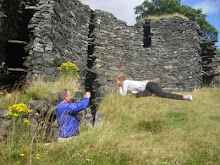
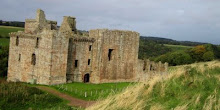
Dun Telve, Glenelg
There were  about 500 brochs in Scotland, most of them on coasts where stone is readily available. Sadly, many have since been used as convenient quarries. Dun Telve (above) was depleted to build the nearby barracks at Bernera. The only broch still at its original height is Mousa, on a small island in Shetland.

Mousa Broch, Shetland
All brochs are round and very slightly concave, like a cooling tower. Apparently, if they were not double-skinned, they would collapse (I wonder how long it took to learn this!). Remember, they are built without mortar.

There's still a lot we don't know about brochs (not least why they were built). To improve our knowledge, the Caithness Broch Project aims to build a broch which will act as a visitor centre. It's an ambitious undertaking. Ian Armit, in his book 'Towers in the North', quotes an architect's estimate that building a broch would take 400 man days of specialist labour and 5,600 man days of unskilled assistance, assuming that the stone has first been gathered. I salute them!

PS. It is generally accepted that the brochs had a timber and thatch roof. Personally I cannot see how this could have been the case. Could iron age man have constructed a timber roof with a diameter of 18.3 metres (Dun Telve) ten metres above the ground? Would he go to all this trouble to live in darkness, the only light coming from a fire and a low door (which was presumably closed for much of the time)?

Wednesday, January 23, 2019

The enduring riddle of the Pictish symbol stones


They are the hieroglyphs of Scotland. But we have not yet found a Caledonian Rosetta Stone to interpret them.

There are thought to be about three dozen different ‘Pictish symbols’ carved in different combinations on a few hundred extant stones around Scotland – usually found in the traditional Pictish heartland of central and north-eastern Scotland. Some are combined with Christian symbology on magnificent stone crosses (or slabs with crosses engraved on them).

For a while after their conversion, the Picts used Christian images together with the old symbols. Sometimes it seems as if the crosses were engraved on older pagan stones. Many of them also include hunting scenes or other depictions of dark age aristocratic and military activity.

What they mean nobody knows for sure, even though numerous clans such as the MacGregors and MacNaghtens claim Pictish ancestry.

This magnificent specimen, which I visited last week, stands at Wester Fowlis in Strathearn, not far from the pretty spa town of Crieff. On one side is an extraordinary engraved cross, notable for its protruding arms. On the other, a series of hunting scenes with the tell-tale Pictish symbols of a ‘mirror’ and a ‘double disc’.


The one in the photo is actually a replica, with the real thing kept sheltered in the nearby church. It’s open and you can in and see it – a great example of the many historical sites and works of art that can be experiences for free in Scotland.

What do the symbols signify?

Some have speculated that, in different combinations, they depict various clans, territories, individual nobles or noblewoman. Although they are not usually located on burial sites, they may have religious connotations.

I feel sure that one day someone will either crack it logically or discover something that unlocks the code.

Maybe language has something to do with it. When I was a boy, it was thought that Pictish was a language largely separate from the two Celtic languages of northern Britain – Gaelic and Brittonic (early Welsh). Most scholars now think that it was similar to Brittonic.

Either way it was apparently replaced by Gaelic in the period after the union of the Picts and Scots in the early middle ages. As with the symbols, there is little hard evidence as to its nature.

But the idea that Pictish was eradicated by Gaelic has always seemed a little odd to me. The supposition is that the ruling elite became Gaelic speaking and, quite rapidly, imposed its language on everyone else. This didn’t really happen in other similar situations in the British Isles or elsewhere in Europe unless there was an accompanying movement of peoples.

Perhaps Pictish was really much more like Gaelic in the first place, and the clue to its symbology will come from that source.

At any rate, I have no real idea, except that it is a fascinating riddle!

Tom Miers
For a memorable holiday exploring Scotland's heritage and culture, check out the Clans and Castles website