Thursday, September 06, 2007

The Clans of Lochaber

Following the Battle of Culloden, the Duke of Cumberland suggested that men from the Clans of Lochaber - the most troublesome Jacobite clans - should be branded on the forehead with a 'Z' when deported to Carolina, so that if a man should return to Scotland, he could easily be identified as a villain. Thankfully the idea was never put into practice.

Lochaber is broadly the area round Fort William (it is no coincidence that Fort William was the first government fort in the Highlands). I was down there yesterday at the invitation of Lochaber College; we were discussing with Andy Mckenna who runs the definitive website on the area how we might provide an enhanced service to worldwide members of the local clans - Camerons, Macleans and MacDonalds - visiting their clan lands. More on this later.

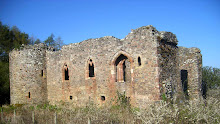
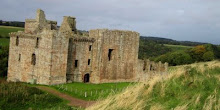
On the way back I was more than delighted to see that the principal seat of one of these clans, the MacDonnells of Glengarry, is finally being consolidated. Perhaps the collapse of both stair towers has prompted some overdue support from the authorities. Credit for getting this underway must go to David and Janetta MacCallum of Glengarry Castle Hotel.

Prince Charles Edward reportedly arrived at Invergarry Castle late in the night following the Battle of Culloden. There were warm embers in the grate but no people, food or drink. Old Glengarry, having lost a son in the campaign and unsure who might be a-knocking on his door that tragic night, was presumably taking no risks. The castle was nevertheless later burned by government troops.

Although the collapse of the stairs means there is no access to the upper floors, this is still a noble ruin and a 'viewing platform' is planned. What a rich heritage of 17th century castles we would have in the Highlands were it not for that misconceived rising!

Sunday, August 12, 2007

Scotland's European landowners

Yesterday I wrote that 19th century European aristocracts would visit the Highlands and wear the kilt. Today I read in the paper that Vladimir Lisin, Russia's second richest man, has bought Aberuchill castle in Perthshire and the associated 3,300-acre estate. Until his recent sad death, Paul Van Vlissingen a Dutchman an ardent environmentalist, was Scotland's richest landowner. Then there is the Swedish millionairess Sigrid van Rausing, also an environmentalist who owns Coignafern estate. It seems that the new European (industrial) aristocrats are even more committed to the Highlands, and perhaps to the environment here, than were the tsars and princes who visited Queen Victoria at Balmoral and got appropriately togged up for the occasion.

Saturday, August 11, 2007

The Kilt

We've had a cousin from Canada staying for a few days. Good fun, and on the second to last day he revealed that he had a kilt with him. But not a tartan kilt. One with 'cargo pockets'. My mind went back to the embarrassing spectacle of Jack McConnell, then First Minister of Scotland, wearing a pin stripe kilt for Tartan Week in New York, and I wasn't desperately keen to see this 'Freedom Kilt' from Victoria, BC.

I have no commercial relationship with Freedom Kilts, but I have to say that it is much more like the garment that Highlanders used to wear than most kilts about the place. Firstly, the colour is authentic: it is broadly sheep-coloured, as would be the original plaid (Gaelic for blanket) that the Highlanders used to wind about themselves. Second it is tough - in this case actually cotton twill, but the heavy woollen kilts in the Middle Ages were designed for hard labour, not just 24/7 but 24/365 and beyond. This kilt has a small pocket for a cell phone - not very medieval certainly, but in those days a similar hidden pocket was sewn in for a sgian dubh - a small knife, traditionally of black bog oak, which was never surrendered to a host, or a victor.

In Victorian times the sgian dubh shifted to the stocking. Queen Victoria and Prince Albert had embraced Highland Dress and traditions with great enthusiasm, leading the fashion from their rebuilt castle at Balmoral. The drab working dress of the Highlander, or a variation thereof, had suddenly became essential wear for not only British, but European aristocracy whilst in Scotland. There is even a picture of four year old Prince William of Prussia, later 'Kaiser Bill' of the Great War, in a kilt!

Thank you, Queen Victoria, for saving the kilt from probable extinction! The eccentric conventions that grew up around it - who should wear what and how - are a small price to pay.

More on kilts and tartans in my small book, 'Scottish Clans and Tartans'

Sunday, August 05, 2007

Hard questions

It's good way to earn a living, I often think: showing people Scotland. This weekend has been a welcome break from the office, and early plans for 2008 holidays. The weather has been kind, the people receptive and I've had a lovely couple of days guiding. On Saturday my clients were two charming couples from Maryland just embarking on one of our holidays; the girls attracted principally by the Diana Gabaldon books, the boys by the golf courses. Lauren had done her homework and was thirsty for more knowledge. Questions came thick and fast from them all. 'Why has Inverness Castle got crosses on it?' 'Should Bonnie Prince Charlie have continued on to London?' 'Did the beaker people build the Clava Cairns?' 'Will we ever get those girls out of the gift shop?'

On Sunday it was a small group from a cruise ship and the questions were somehow different. 'What is the range of a Brown Bess musket?' 'What are Scotland's principal imports?'

It's good fun being forced to think, and I believe I made a reasonable stab at all of the above, but two years ago, (I remember it well), I was completely floored by a twelve year old boy called Giovanni Fusco. He asked, amongst things: 'How far south did they worship the Norse Gods?' and 'Were the Picts the most warlike of the Celtic peoples?'

Answers to either question in the Comments column please.

Saturday, July 21, 2007

The Dun Bonnet of Foyers

In Neil Gunn’s novel, Highland River, a Canadian of Scots Highland descent meets two Highlanders, Angus and Ken, in the trenches of France. The Canadian speaks Gaelic and talks knowledgeably about Highland culture. In one exchange he refers to the ‘Province of Cat’ (broadly Caithness).

‘Do you know’, he said turning to Ken, ‘that Angus here didn’t know what the Province of Cat meant!’

For an instant the eyes held Ken, and then the Canadian-born clansman laughed. Say, you’re not too sure yourself! And you call yourselves Highlanders!

This came to mind when a lady from Arkansas remarked to me that she would quite like to visit the cave of the Dun Bonnet near Foyers on Loch Ness.

‘The Dun Bonnet’, I said slowly, desperately searching the mental archives. I couldn’t stall her and she told me the story which involved a Fraser who had hidden out from the redcoats for several years after Culloden. His faithful kinsfolk had kept him supplied with food and water.

The fact that Scots abroad are often substantially more knowledgeable about our heritage than Scots at home was vividly brought home to me at the Grandfather Mountain Highland Games last week, an event which outdoes any Highland Games back home. But back to the Dun Bonnet...

His real name was James Fraser, the IX of Foyers and having fought at Culloden, he reportedly spent about seven years in this cave. His hideout was well known to the locals and they called him Bonaid Odhair, Dun Bonnet, so that they could talk freely about him.

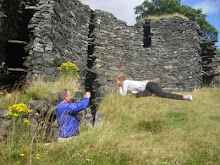
However if the locals in the 18th century knew the cave well, those of the 21st (at least those we asked), were unaware of its existence. Nothing daunted we scaled Carn Dearg and made our way through a thick spruce platation to the mossy summit where we found The Cave. Well, we found A Cave - which was satisfaction enough.

Now at least, I know all about the the 'Bonaid Odhair'.

(Bonaid, incidentally, is another Gaelic word which has been adopted by English.)

If you would like to explore your Scottish knowledge on the ground, then just drop me an email.