Monday, September 10, 2007
Who owns Scotland?
When guiding last month I caused some interest by quoting the statistic that 1/4 of rural land in Scotland is owned by just 66 landowners. Today I finally got around to checking that I had got this right. Happily so. Further details from Who Owns Scotland

Sunday, September 09, 2007
Dun Bonnet's Cave
 |
| Northern Entrance |
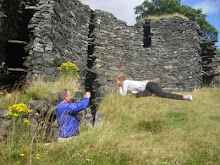
As previously reported the cave is not a tourist attraction. Indeed the moss on the boulders surrounding it looked as if it had been growing undisturbed for a decade or more. It is also not particularly roomy.
James Fraser was apparently kept supplied to some extent by the good people of Foyers and no doubt he did some hunting, fishing and trapping. It seems to me that seven weeks concealed in this cave, with a little bread and other essentials appearing every second day, would be a good selection exercise for a potential SAS recruit. But seven years with no known end date would have taken an enormous physical and mental toll, even on a tough Highlander! I can't understand why he didn't head off to exile in France like the rest of them.
An anonymous comment on my July 'Dun Bonnet' post noted, Fans of Diana Gabaldon's Outlander series will know well the story of the Dun Bonnet from the 3rd novel of the series, Voyager. The one difference being that in Voyager, it is the Dun Bonnet of Lallybroch!
 |
| Floor of the cave (not great for sleeping!) |
Thursday, September 06, 2007
The Clans of Lochaber
Following the Battle of Culloden, the Duke of Cumberland suggested that men from the Clans of Lochaber - the most troublesome Jacobite clans - should be branded on the forehead with a 'Z' when deported to Carolina, so that if a man should return to Scotland, he could easily be identified as a villain. Thankfully the idea was never put into practice.
Lochaber is broadly the area round Fort William (it is no coincidence that Fort William was the first government fort in the Highlands). I was down there yesterday at the invitation of Lochaber College; we were discussing with Andy Mckenna who runs the definitive website on the area how we might provide an enhanced service to worldwide members of the local clans - Camerons, Macleans and MacDonalds - visiting their clan lands. More on this later.

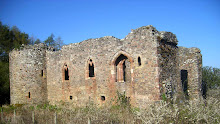
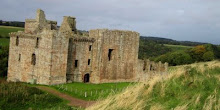
On the way back I was more than delighted to see that the principal seat of one of these clans, the MacDonnells of Glengarry, is finally being consolidated. Perhaps the collapse of both stair towers has prompted some overdue support from the authorities. Credit for getting this underway must go to David and Janetta MacCallum of Glengarry Castle Hotel.
Prince Charles Edward reportedly arrived at Invergarry Castle late in the night following the Battle of Culloden. There were warm embers in the grate but no people, food or drink. Old Glengarry, having lost a son in the campaign and unsure who might be a-knocking on his door that tragic night, was presumably taking no risks. The castle was nevertheless later burned by government troops.
Although the collapse of the stairs means there is no access to the upper floors, this is still a noble ruin and a 'viewing platform' is planned. What a rich heritage of 17th century castles we would have in the Highlands were it not for that misconceived rising!
Lochaber is broadly the area round Fort William (it is no coincidence that Fort William was the first government fort in the Highlands). I was down there yesterday at the invitation of Lochaber College; we were discussing with Andy Mckenna who runs the definitive website on the area how we might provide an enhanced service to worldwide members of the local clans - Camerons, Macleans and MacDonalds - visiting their clan lands. More on this later.

On the way back I was more than delighted to see that the principal seat of one of these clans, the MacDonnells of Glengarry, is finally being consolidated. Perhaps the collapse of both stair towers has prompted some overdue support from the authorities. Credit for getting this underway must go to David and Janetta MacCallum of Glengarry Castle Hotel.
Prince Charles Edward reportedly arrived at Invergarry Castle late in the night following the Battle of Culloden. There were warm embers in the grate but no people, food or drink. Old Glengarry, having lost a son in the campaign and unsure who might be a-knocking on his door that tragic night, was presumably taking no risks. The castle was nevertheless later burned by government troops.
Although the collapse of the stairs means there is no access to the upper floors, this is still a noble ruin and a 'viewing platform' is planned. What a rich heritage of 17th century castles we would have in the Highlands were it not for that misconceived rising!
Sunday, August 12, 2007
Scotland's European landowners
Yesterday I wrote that 19th century European aristocracts would visit the Highlands and wear the kilt. Today I read in the paper that Vladimir Lisin, Russia's second richest man, has bought Aberuchill castle in Perthshire and the associated 3,300-acre estate. Until his recent sad death, Paul Van Vlissingen a Dutchman an ardent environmentalist, was Scotland's richest landowner. Then there is the Swedish millionairess Sigrid van Rausing, also an environmentalist who owns Coignafern estate. It seems that the new European (industrial) aristocrats are even more committed to the Highlands, and perhaps to the environment here, than were the tsars and princes who visited Queen Victoria at Balmoral and got appropriately togged up for the occasion.
Saturday, August 11, 2007
The Kilt
 We've had a cousin from Canada staying for a few days. Good fun, and on the second to last day he revealed that he had a kilt with him. But not a tartan kilt. One with 'cargo pockets'. My mind went back to the embarrassing spectacle of Jack McConnell, then First Minister of Scotland, wearing a pin stripe kilt for Tartan Week in New York, and I wasn't desperately keen to see this 'Freedom Kilt' from Victoria, BC.
I have no commercial relationship with Freedom Kilts, but I have to say that it is much more like the garment that Highlanders used to wear than most kilts about the place. Firstly, the colour is authentic: it is broadly sheep-coloured, as would be the original plaid (Gaelic for blanket) that the Highlanders used to wind about themselves. Second it is tough - in this case actually cotton twill, but the heavy woollen kilts in the Middle Ages were designed for hard labour, not just 24/7 but 24/365 and beyond. This kilt has a small pocket for a cell phone - not very medieval certainly, but in those days a similar hidden pocket was sewn in for a sgian dubh - a small knife, traditionally of black bog oak, which was never surrendered to a host, or a victor.
In Victorian times the sgian dubh shifted to the stocking. Queen Victoria and Prince Albert had embraced Highland Dress and traditions with great enthusiasm, leading the fashion from their rebuilt castle at Balmoral. The drab working dress of the Highlander, or a variation thereof, had suddenly became essential wear for not only British, but European aristocracy whilst in Scotland. There is even a picture of four year old Prince William of Prussia, later 'Kaiser Bill' of the Great War, in a kilt!
Thank you, Queen Victoria, for saving the kilt from probable extinction! The eccentric conventions that grew up around it - who should wear what and how - are a small price to pay.
More on kilts and tartans in my small book, 'Scottish Clans and Tartans'
Subscribe to:
Posts (Atom)


 Posts
Posts