Monday, October 08, 2007

Sgurr nan Gillean

On Friday night I was at the Sligachan Hotel on the Isle of Skye, enjoying a pint or two of Skye Ale, a fine brew, made on the premises. The brewery is new, but there has been drinking on this site since the first Sligachan Market was opened by Col MacLeod of MacLeod on 22 October 1794. This was a traditional 'drovers stance', where about 6,000 cattle were assembled each year, to be sold on to the drovers who would swim them across to the mainland and drive them on to markets in the south. The new Sligachan market attracted a multitude of folk - tacksmen, drovers, cottars, tinkers, factors, ghillies, all enjoying a chance to meet and trade and brag and drink against the backdrop of the noise and stench of cattle, sheep and Skye ponies (sold to work in the Lanarkshire coalfields) all of them unsettled at leaving their home turf.


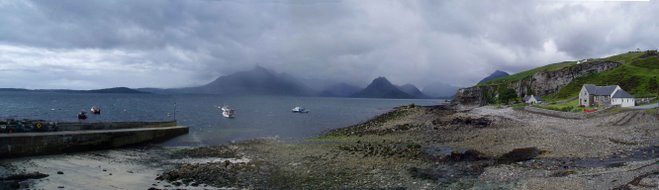
But now the inn is distinctly civilised. On Saturday it was full of nervous Englishmen, curtailing their climbing to see if England could survive in the Rugby World Cup (they did). I was there with an ex submarine commander friend, for a day's walking in the Cuillins (seen above on a perfect evening last month). All week the weather forecast showed an unusual full sun icon for Saturday, but we set out for Sgurr nan Gillean on a misty wet morning (see October's picture). The day improved and there were some great views over to Raasay and up to Portree and the 'Old Man of Storr'. But the clouds drifted over the tops and we did not feel competent to press on to the famous Cuillin Ridge. It was a thoroughly enjoyable, if exhausting, day. This was about as high as we got (the more rounded 'Red Cuillins' are in the background)...

Wednesday, September 26, 2007

Diana Gabaldon Tour, Day Five

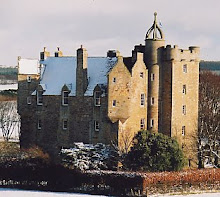
Monday was Crathes Castle with its sensational gardens (right) and 'Royal Deeside' which nearly lived up to its name: we missed Prince Charles and the Duchess of Cornwall by 20 minutes at McEwans of Perth in Ballater.

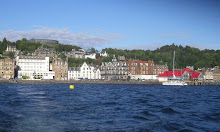
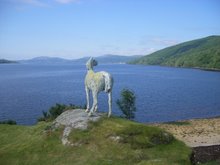
Yesterday was the trip over here, to Skye. We had planned to come by the six car Glenelg Ferry but it wasn't running, so we swung by Eilean Donan Castle, allowing some to renew old acquaintances, and Irina to take this beautiful shot of Lochalsh with Skye in the distance.


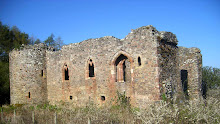
Today we saw Dunvegan Castle, seat of the Macleods, looking proudly over Loch Dunvegan. But beyond the far shore of that loch, beyond the world famous Three Chimneys Restaurant, lie the villages that were 'cleared' by the MacLeods in the 1780s. We visited one of them. It used to be a remote, hard working, close-knit community; now just overgrown stone cottages with a tumbledown church, first consecrated about 1300 years ago, all set by a spectacular waterfall, the shore not far below. As with all clearance villages, it was a thought provoking visit: the residents had committed no crime, there was no Court of Appeal, just the promise of better land in Carolina... if they ever got there.

If we needed to know more of those times, of that society, and indeed of the one before it, there was no better oracle than Seoras, the storyteller, clad in traditional belted plaid, sitting by the fire in his 'Black House'. As he talked of the myths and legends of Skye, as he stroked his beard and the peat smoke wafted round the simple room, we were all a little mesmerised and left pondering on druids and magical wells.

Sunday, September 23, 2007

Day Two of the 2007 Diana Gabaldon Tour

It was a pleasure to see happy, if tired, faces at Aviemore Railway Station yesterday, amongst them two old friends from last year's tour. A refreshing walk down to the River Spey, the evening light on the Cairngorm Mountains, and an excellent dinner at Corrour House set everyone up for an interesting first day.

The Clava Cairns with the split stone might have been today's highlight. Or maybe Culloden Battlefield. But the deepest impression was probably left by the Lovat Mausoleum at the old Wardlaw Cemetery. The memorial plaques on the wall date back to 1634, and in the centre, secured by a padlocked cover, is the entrance to a crypt. The 11th Lord Lovat, most notorious of his line and known as the 'Old Fox' lies down there. Hauling on the two cast iron rings to lift the heavy oak trapdoor and reveal the stairs was a touch dramatic. Not everyone decided to go down; but those who did found several lead-lined coffins, one of which, poignantly, is that of a child. In another, so they say, lies the corpse of the 11th lord, beheaded in 1747 for his part in the 1745 Rising; his body was smuggled north whilst his head was still on display in London.

Tonight we returned to Corrour, and to a fascinating presentation on Culloden by Hugh Allison who also signed copies of his new book, 'Culloden Tales'.

Here is the group on the battlefield.

Monday, September 10, 2007

Who owns Scotland?

When guiding last month I caused some interest by quoting the statistic that 1/4 of rural land in Scotland is owned by just 66 landowners. Today I finally got around to checking that I had got this right. Happily so. Further details from Who Owns Scotland

Sunday, September 09, 2007

Dun Bonnet's Cave

Northern Entrance
Back in July I found myself on an unscheduled search for the cave of the 'Dun Bonnet of Foyers', aka. James Fraser, the IXth of Foyers who reportedly hid out there for seven years following Culloden. Although I published a picture of a cave then, both of us who were there knew that it was not the right one. Today my elder son and I went off on a serious search - and returned successful.

As previously reported the cave is not a tourist attraction. Indeed the moss on the boulders surrounding it looked as if it had been growing undisturbed for a decade or more. It is also not particularly roomy.

James Fraser was apparently kept supplied to some extent by the good people of Foyers and no doubt he did some hunting, fishing and trapping. It seems to me that seven weeks concealed in this cave, with a little bread and other essentials appearing every second day, would be a good selection exercise for a potential SAS recruit. But seven years with no known end date would have taken an enormous physical and mental toll, even on a tough Highlander! I can't understand why he didn't head off to exile in France like the rest of them.

An anonymous comment on my July 'Dun Bonnet' post noted, Fans of Diana Gabaldon's Outlander series will know well the story of the Dun Bonnet from the 3rd novel of the series, Voyager. The one difference being that in Voyager, it is the Dun Bonnet of Lallybroch!

Floor of the cave (not great for sleeping!)
If you would like to be guided 'off the beaten track' to investigate some Scottish heritage or history, just email me .