Friday, November 09, 2007

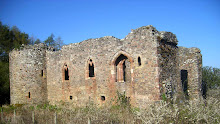
Rait Castle

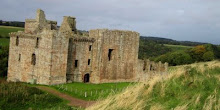
Last weekend I took a walk up to Rait Castle, just a mile or so from my house, to gather some sloes for the winter's sloe gin. The sloes were excellent but it was depressing to see the continuing state of the castle.

Rait is the best surviving example of a 13th century 'Hall Castle'. It boasts elegant window tracery carved from single pieces of sandstone (right), its tower still has a perfect domed ceiling (below).

And yet this castle stands neglected. The old courtyard is swamped by blackthorn and trees grow out of the wall-heads, their roots boring into the 800 year old mortar.


For several years now, I have been trying to arrange for Rait Castle to be restored, not for habitation nor for a visitor centre, but just to stop it deteriorating further. At one stage in April 2005 we managed to make a start on clearing the scrub but then there was a confusion about ownership and work stopped. Now we appear to be back to Square One and, along with some others, I am therefore relaunching the campaign to have the castle restored and the courtyard cleared. Watch this space!

Friday, November 02, 2007

Madainn Mhath. Moran taing for an iongantach latha-saor!

I always try to immerse guests in local culture when I can. My last tour was in the Gaelic speaking Highlands, but I hadn't expected this to be reflected in an appreciative email (above) that followed. Ann from Texas went on, "I told my husband that we were moving to Skye when we retire so I can go to the college for a year".

'The College' she mentions is the flourishing Gaelic College at Sabhal Mor Ostaig (above). And that's my small contribution to Latha Mòr na Gaidhlig, the Big Gaelic Day, which was held at Aviemore, or An Aghaidh Mòr, yesterday. It was also yesterday that I gave a talk on Clans to a group of American artists at Brodie Castle. Their paintings, featuring some wonderful Scottish castles, may be seen shortly at Loch Vale Fine Art, Estes Park, Colorado. But the conversation dwelled on Gaelic - in particular words that have been absorbed into English. (I was much helped by Elizabeth who speaks Gaelic fluently thanks to an Irish father)...

Gleann means valley, clann children, plaide blanket and uisge-beatha whisky. Also, 'Galore' comes from gu le
òr meaning enough or plenty, 'dosh' from duais meaning wages, and 'slogan' from sluagh-ghairm meaning battle cry. And if you should need to let off steam without being understood - amadan means idiot!

Thursday, November 01, 2007

Black Cattle

Although traditional Highland cattle are generally thought to be a nice golden brown colour, actually the earliest ones were black. Only in the 19th century did the larger brown variety become popular. Until the 18th century and in many cases beyond, cattle were the Highlanders' wealth, even though beef was a luxury. The cattle were driven south in the autumn to provide much needed silver for these subsistence farmers. So important were the black cattle that they appear in everyday language. The Blackwatch Regiment was founded in 1725 to watch over the black cattle and reduce the amount of cattle lifting. 'Blackmail' comes from the same root: mal is the Gaelic for rent and blackmail was what had to be paid to the likes of Rob Roy to ensure that your cattle were safe.

Sunday, October 28, 2007

Dun Bonnet cave from the inside

Looking south from the cave
Today I finally got back to the Dun Bonnet cave - armed with a camera, tape measure, torch and a fellow guide to ensure I didn't disappear for ever amongst the jumble of rocks. Hauling myself up to the entry I squeezed over the muddy threshold and found myself in a narrow Y-shaped cave, in which I could walk about, though not without difficulty as the 'floor' is comprised of jagged boulders. There are two openings (the other requiring an even more precipitate approach) and what looks like a perfect chimney from which smoke would be difficult to detect. The cave is about 45 foot across and varies from three foot to about seven foot wide. I also discovered that caves are not easy to photograph without proper lighting and a few objects to provide perspective! However some photos looking out worked out OK. Above is the 'other' entrance from the inside and below is the chimney.


For anyone who has not read the previous postings on the Dun Bonnet, this is a cave near Foyers on Loch Ness where James Fraser of Foyers reportedly spent seven years after the Battle of Culloden, evading capture by the redcoats.

If you would like to visit the Dun Bonnet cave or join one of our Outlander Tours, do please get in touch.

Wednesday, October 24, 2007

An 18th century farmhouse

Fans of Diana Gabaldon in particular often ask me if they can see an 18th century highland farmhouse. They want to get a picture in their minds of the fictional 'Lally Broch'. There are a few nice old farmhouses near Inverness but they often have very un-eighteenth century additions like dormer windows and conservatories.

But earlier this month I was persuaded by wife and daughter to do a little white water rafting in Perthshire. It was a good day, and both my daughter and I took a dip in the River Tay - a shock for the salmon. Later we went for a hot chocolate right by one of the most perfect early 18th century farmhouses you could wish for. Notice the ridges on the chimney pots to throw the rain out on to the original thatch. The owner told me that initially there were no windows at the back, only at the front.