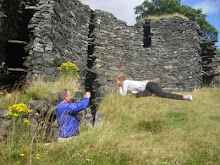
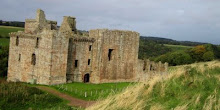
On a hill overlooking the Cromarty Firth is a striking, most un-highland monument. I guess that travellers must have been wondering what on earth it is ever since its erection in 1782. In fact it is a replica of the gates of Negapatam in South East India - originally a Dutch colony, won by the British in 1781.
Responsible for this success was Sir Hector Munro, 8th of Novar (1726 - 1805) who won fame and fortune as a British Army Officer in India. When he retired to Scotland the following year he found that in the midst of the Highland Clearances many Munros and others in the area were unemployed and hungry, so he paid them all to carry stones to the top of Cnoc Fyrish where the monument to celebrate his triumph was erected.
Tragically, Sir Hector's two sons were both killed in India, one by a tiger and one by a shark in the Bay of Bengal and the estate passed to his daughter whose descendants still own it.
And, until yesterday, that was all I knew of the Munros of Novar.
I now learn that Sir Hector's nephew, Hugh Anderson Johnstone Munro of Novar was one of the most notable art collectors of his day and a close friend of the English artist J. M. W. Turner. Munro eventually owned fifteen oil paintings by Turner and one hundred and nine of his water colours. One of his favourites, 'Modern Rome - Campo Vaccino' was sold by Munro's heirs in 1878 to the Earl of Roseberry for the astonishing price (at that time) of 4,450 guineas. It comes under the hammer for the second time tomorrow in a Sotheby's sale in London with an estimate of £12-18 million.
A blow, though, for the National Gallery of Scotland, to whom it has been on loan since 1978.
Tuesday, July 06, 2010
Tuesday, June 08, 2010
The Hanging of Neil MacLeod.
Yesterday, as part of the Nairn Book and Arts Festival, I was asked to introduce Alistair Moffat, author of 'Highland Clans'. Alistair has written a range of books, largely on Scottish history; and until last month I had read none of them.
I was intrigued by 'Highland Clans' - many of the points he makes, many of the anecdotes that he highlights, are those that I use on my own tours. But one extraordinary anecdote was new to me....
In 1597 the Edinburgh Parliament passed an act to enable the foundation of three new towns in the Highlands. One of these was to be on the Isle of Lewis, traditional land of the MacLeod clan. The name given to the company formed to establish the town on Lewis speaks volumes: "The Gentlemen Adventurers for the Conquering of the Isles of Lewis". Like those who were colonising the east coast of North America, they dug a ditch around their settlement and built a stockade. And, just as in Virginia, the indigenous inhabitants took exception. In 1601 the Adventurers retreated but legally they were still owners of the island and they sold it to the Mackenzies who established themselves with 700 men. Neil MacLeod, chief of the clan, resisted, was arrested and eventually stood on a gallows in Edinburgh's Royal Mile.
MacLeod, a Gaelic speaker, did not understand anything that was said to him - until the hangman referred to him as bhodach, 'old man'. He knew that word and took exception, headbutting the younger man; and the crowd bayed for the blood of this savage. They got their blood of course. And the idea of Highlanders as savages continued until and beyond the Battle of Culloden in 1746 when this view of an alien people, was encouraged by government generals whose men had several times fled in the face of the Highland Charge (but stood firm on that day).
For centuries Scotland was divided. In the north, a nation of subsistence farmers spoke Gaelic, wore tartan, played bagpipes and recognised no authority beyond their clan chief. The other nation (which controlled affairs) did none of the above and they despised, feared and hated their northern neighbours.
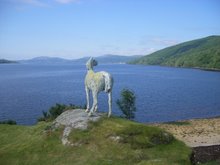
This has led to many problems and complications. The least of which, perhaps, is whether Lewis is MacLeod clan territory or rightly belongs to the Mackenzies whose traditional clan chief took his name from Loch Seaforth on Lewis (above).
I was intrigued by 'Highland Clans' - many of the points he makes, many of the anecdotes that he highlights, are those that I use on my own tours. But one extraordinary anecdote was new to me....
In 1597 the Edinburgh Parliament passed an act to enable the foundation of three new towns in the Highlands. One of these was to be on the Isle of Lewis, traditional land of the MacLeod clan. The name given to the company formed to establish the town on Lewis speaks volumes: "The Gentlemen Adventurers for the Conquering of the Isles of Lewis". Like those who were colonising the east coast of North America, they dug a ditch around their settlement and built a stockade. And, just as in Virginia, the indigenous inhabitants took exception. In 1601 the Adventurers retreated but legally they were still owners of the island and they sold it to the Mackenzies who established themselves with 700 men. Neil MacLeod, chief of the clan, resisted, was arrested and eventually stood on a gallows in Edinburgh's Royal Mile.MacLeod, a Gaelic speaker, did not understand anything that was said to him - until the hangman referred to him as bhodach, 'old man'. He knew that word and took exception, headbutting the younger man; and the crowd bayed for the blood of this savage. They got their blood of course. And the idea of Highlanders as savages continued until and beyond the Battle of Culloden in 1746 when this view of an alien people, was encouraged by government generals whose men had several times fled in the face of the Highland Charge (but stood firm on that day).
For centuries Scotland was divided. In the north, a nation of subsistence farmers spoke Gaelic, wore tartan, played bagpipes and recognised no authority beyond their clan chief. The other nation (which controlled affairs) did none of the above and they despised, feared and hated their northern neighbours.
This has led to many problems and complications. The least of which, perhaps, is whether Lewis is MacLeod clan territory or rightly belongs to the Mackenzies whose traditional clan chief took his name from Loch Seaforth on Lewis (above).
Wednesday, June 02, 2010
The Teaghlach Wood
I visited the Teaghlach Wood at the weekend and met Angus Crabbie (below) who heads up Trees4Scotland.
Teaghlach, pronounced 'Chowlach' means family or household and it was launched, appropriately, at the time of The Gathering 2009 with donations from those attending to provide a lasting (and living) legacy of the occasion. It is still growing (in both senses of the word) and will continue to do so as part of Trees4Scotland's plan to expand Scottish woodland. This expansion is in part funded by those who wish to offset their carbon emissions through a project in Scotland and shortly we will be launching our own project to plant a tree for every booking that we take - and encouraging others to join us.
More on that later, but meantime it was great to see this enterprising project underway in the Perthshire countryside. Red kites were circling overhead, sand martins swooping around us and primroses huddled on the banks of the burn.
And once the trees grow... there will be even more wildlife.
Perhaps, with your help, it will one day rival the wonderful Carrifran Wildwood.
Teaghlach, pronounced 'Chowlach' means family or household and it was launched, appropriately, at the time of The Gathering 2009 with donations from those attending to provide a lasting (and living) legacy of the occasion. It is still growing (in both senses of the word) and will continue to do so as part of Trees4Scotland's plan to expand Scottish woodland. This expansion is in part funded by those who wish to offset their carbon emissions through a project in Scotland and shortly we will be launching our own project to plant a tree for every booking that we take - and encouraging others to join us.
More on that later, but meantime it was great to see this enterprising project underway in the Perthshire countryside. Red kites were circling overhead, sand martins swooping around us and primroses huddled on the banks of the burn.And once the trees grow... there will be even more wildlife.
Perhaps, with your help, it will one day rival the wonderful Carrifran Wildwood.
Friday, May 21, 2010
The Termit Stone
Two Mackintoshes from Pennsylvania were here last weekend searching for their roots. The Mackintoshes were traditional leaders of Clan Chattan (pronounced 'hatton') a confederacy of small clans, based south of Inverness.
Whilst doing a little research for the trip I came upon the signing of the 'Clan Chattan Band of Union' at Termit in 1609, and the stone laid to commemorate this event in 2009.
Termit? Try it in in Google and it suggests you mean 'termite'. Look on the map and it isn't there!
Well, now I can reveal to anyone who is interested that Termit (no buildings remaining) is about five miles east of Inverness on land now known as Moraystoun. The stone is accessible at Grid 753488 and, as you can see, it is looking well in the landscape.
Amongst the constituent Clan Chattan clans are: Mackintosh, Shaw, MacLean of Dochgarroch, MacGillivray, MacQueen, MacPherson, Davidson, MacBean, MacThomas, MacPhail, Cattanach, Ritchie, MacCombie and Farquharson.
So why did these smaller clans feel the need to band together? The official explanation in the Clan Chattan newsletter is here. More generally, I would suggest that since James VI, King of Scots, had recently accepted the throne of England, royal control of the Highlands was increasingly arm's length. The Gordons, the Frasers, the Camerons and the MacDonalds were all big beasts in the north. The smaller clans had to come together, or risk being eaten up.
Clan Chattan led the Highland Charge at Culloden in 1746.
Whilst doing a little research for the trip I came upon the signing of the 'Clan Chattan Band of Union' at Termit in 1609, and the stone laid to commemorate this event in 2009.
Termit? Try it in in Google and it suggests you mean 'termite'. Look on the map and it isn't there!
Well, now I can reveal to anyone who is interested that Termit (no buildings remaining) is about five miles east of Inverness on land now known as Moraystoun. The stone is accessible at Grid 753488 and, as you can see, it is looking well in the landscape.
Amongst the constituent Clan Chattan clans are: Mackintosh, Shaw, MacLean of Dochgarroch, MacGillivray, MacQueen, MacPherson, Davidson, MacBean, MacThomas, MacPhail, Cattanach, Ritchie, MacCombie and Farquharson.
So why did these smaller clans feel the need to band together? The official explanation in the Clan Chattan newsletter is here. More generally, I would suggest that since James VI, King of Scots, had recently accepted the throne of England, royal control of the Highlands was increasingly arm's length. The Gordons, the Frasers, the Camerons and the MacDonalds were all big beasts in the north. The smaller clans had to come together, or risk being eaten up.
Clan Chattan led the Highland Charge at Culloden in 1746.
Friday, April 30, 2010
Étienne Jacques Joseph Alexandre Macdonald, Maréchal d'Empire, Duc de Tarente.
At Howbeg on South Uist today there was a ceremony to mark the unveiling of a plaque to the memory of one of Napoleon Bonaparte's most distinguished generals: Marshall MacDonald.
(I am obliged to Uist Lady for the picture).
The Maréchal's father Neil MacEachen was born on South Uist. A studious young man, MacEachan went off to the Scots College in Paris to study for the priesthood. He returned to find the 1745 Rising in full swing. It seems that he fought at Culloden; what is certain is that he was on that boat which carried 'Bonnie Prince Charlie' over the sea to Skye. MacEachen then stayed with the prince as escort/servant, until they eventually reached France and he had to make his own way in an unfamiliar world. Probably because no one could pronounce his name, he changed it to MacDonald and he joined a community of exiled and impoverished Jacobites at Sancerre. Later the family came along.
Little could poor Neil, whose wife took in washing and did cleaning jobs, have imagined what would happen 34 years later. In 1799: the new French Republic's wars against Britain, Russia and the Austrian Empire were not going well. A faction decided to mount a coup d'état and they needed a general to head it. According to author Jean Didier Hache who has written a book on MacDonald, the first choice general died in Italy, the second choice refused and the third choice was
MacDonald.
MacDonald refused. Napoleon Bonaparte willingly accepted!
In 1825 MacDonald returned to Uist to see his father's birthplace, but having no Gaelic and very little English, the visit did not forge much in the way of ties with the island. He did however return with some good Scottish earth which was buried with him on his death fifteen years later.
We often boast of enlightened18th century Scots who were world leaders in science, medecine, philosophy. It would have been quite nice to have had an Emperor too!
(I am obliged to Uist Lady for the picture).
The Maréchal's father Neil MacEachen was born on South Uist. A studious young man, MacEachan went off to the Scots College in Paris to study for the priesthood. He returned to find the 1745 Rising in full swing. It seems that he fought at Culloden; what is certain is that he was on that boat which carried 'Bonnie Prince Charlie' over the sea to Skye. MacEachen then stayed with the prince as escort/servant, until they eventually reached France and he had to make his own way in an unfamiliar world. Probably because no one could pronounce his name, he changed it to MacDonald and he joined a community of exiled and impoverished Jacobites at Sancerre. Later the family came along.
Little could poor Neil, whose wife took in washing and did cleaning jobs, have imagined what would happen 34 years later. In 1799: the new French Republic's wars against Britain, Russia and the Austrian Empire were not going well. A faction decided to mount a coup d'état and they needed a general to head it. According to author Jean Didier Hache who has written a book on MacDonald, the first choice general died in Italy, the second choice refused and the third choice was
MacDonald.
MacDonald refused. Napoleon Bonaparte willingly accepted!
In 1825 MacDonald returned to Uist to see his father's birthplace, but having no Gaelic and very little English, the visit did not forge much in the way of ties with the island. He did however return with some good Scottish earth which was buried with him on his death fifteen years later.
We often boast of enlightened18th century Scots who were world leaders in science, medecine, philosophy. It would have been quite nice to have had an Emperor too!
Subscribe to:
Comments (Atom)