Tuesday, January 07, 2014

Roxburgh Castle

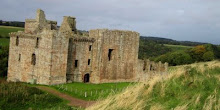
It's difficult to imagine, as I walk by the River Teviot to ruinous Roxburgh Castle, that King David I (1124 - 1153) governed Scotland from here, that it saw royal marriages and births, and was one of the principal strongholds of Scotland, ceded to England (with Edinburgh and Stirling) after the capture of King William 'The Lion' in 1174.


It's a wet and windy January afternoon and it's also hard to imagine an iron cage hanging from these walls, a cage containing a king's sister. She was Mary, sister to Robert the Bruce, held here by the English, 'exposed to public view' from 1306 to 1310, then removed to a convent, (presumably to stop a valuable hostage from dying of exposure). She was released after the Battle of Bannockburn (1314) in exchange for English noblemen.

Ah yes! Bannockburn. There's a happier story! Our last 'home win', 700 years ago on 23 and 24 June. And Roxburgh Castle was taken for the Scots by 'Good' Sir James Douglas earlier that same year by creeping up on it with sixty men disguised, they say, as cattle; though sadly we don't have the exact day to celebrate it. This left Stirling as the only Scottish Castle in English hands... fanfare and cue Bannockburn re-enactment later this year.

But returning to Roxburgh, this is what Andrew Spratt (and he's normally pretty good) thinks it looked like.


The two rivers join just below the illustration and the Teviot was partially diverted (top) to surround the castle with water (just like Caerlaverock on the Solway Firth and Old Inverlochy Castle at Fort William).

Roxburgh changed hands between Scots and English 13 times and was eventually destroyed by the Scots in 1460. But this was another bitter and uncertain time: our king, James II, had been killed standing by a canon, firing on English-held Roxburgh Castle from the grounds of Floors Castle across the Tweed.

The magnificent  building that now smiles benignly across the river is a modern structure (of 1721) but well worth a visit. And if you do go, look for the holly tree marking the spot where James II was killed by his favourite canon. And perhaps you will take time to wander up to the thought-provoking ruins of Roxburgh Castle.


Thursday, August 15, 2013

Authenticity is Everything in this Counterfeit World

I had a birthday the other day and was given a cd by Hugh Laurie (thanks Jamie) who apologises in the liner notes for being a white middle class Englishmen offering songs from black Louisiana in the early 1900s. He goes on to talk of 'furniture dipped in absinthe and towed behind a truck from Nice Table all the way to Wow, What's the Story Behind That???' suggesting that, 'Our alienation from the land, our inoculation against disease, our cultivated fear of hot things, sharp things, fast things... has made us hungry for the real thing, for Truth. If we don't get it we'll settle for its distant cousin, Authenticity.'

Earlier this week I was guiding clients in their clan lands, pulling out scraps of history and relating them to what's there now on the ground. The rocks, the rivers, the corries and to some extent the churches, are easy but most buildings are far removed from those ancient Truths. I'm grateful for the Authenticity of monuments and graveyards.

On Tuesday night I was at a B&B - a typically Scottish Victorian villa  in a small Perthshire town with a lovely garden. We've used it for clients before and they've had a great welcome. As did I, from the charming young landlady and her partner who produced an excellent breakfast. This couple have had the house for a year. They come from Roumania. So, not really authentic. But what if they had been from London, or Glasgow, or Inverness, or the next town down the glen?

Ideally the landlady would have been born and brought up in the town; but there aren't so many of those about. Truths are often hard to pin down - intellectually, historically or for a tour guide on the ground. But for our Clans and Castles clients we serve up as much as we can of that distant cousin, Authenticity.

Book a trip with us and there's one very nice B&B that you won't be staying in.


Friday, May 24, 2013

The Hill Road to Roberton


The hill road to Roberton's a steep road to climb,
But where your foot has crushed it you can smell the scented thyme,
And if your heart's a Border heart, look down to Harden Glen,
And hear the blue hills ringing with the restless hoofs again.

When I moved back to the Borders last year, I was looking forward to living near lovely Tweedside Abbotsford, home of Sir Walter Scott, which reopens to the public on 4 July. But I had forgotten about Will H. Ogilvie who wrote that great poem, The Raiders (too long to quote here but follow the link - it's a wonderful evocation of the romance of the Borders). 

I was recently in Galashiels on a lovely spring afternoon and decided to return to Hawick via 'The Hill Road to Roberton' where Will's ashes were scattered, and pay my respects to his cairn (below). 


It's a beautiful, undulating, moorland road which I will make a point of revisiting in August when the heather is out. But I'd forgotten that as I wound down into the valley of the River Teviot I would pass by 17th century Harden Tower, once home to Auld Wat of Harden (depicted below), one of the most notable of the Border Reivers. 


Which brings us back to his descendant, Sir Walter Scott, who wrote so effectively about 'Auld Wat' in the 'Lay of the Last Minstrel'.

Do make a point of visiting Abbotsford - a lovely and fascinating house with a well designed visitor centre.


Tuesday, May 15, 2012

The Queen's Unfortunate Love of Golf


Mary Queen of Scots (1542 - 1587) is reported to be the first woman to play golf regularly. Now some readers will know how that game can just get a hold of you; it clouds the judgement. So it was for Mary: people noticed that within days of the murder of her husband, Lord Darnley, the Queen was back out with her bag of golf sticks chasing that wee ball along the links. Of course it didn't help that fifteen weeks later she married the Earl of Bothwell, the man generally thought to be her husband's murderer.

Not only was Mary a golfer, but a fine horsewoman, poet, musician, and according to a contemporary "there was no human knowledge she could not talk upon... she used a most gentle style of speech, with kindly majesty mingled with modest reserve". She was also tall, athletic, beautiful. In fact she was just the sort of queen that Scotland needed in the 16th century. But it all went horribly wrong. Golf was the least of her problems; the biggest was... men; she fell in love with the wrong ones. It is a long and tragic story, related in many books and now by the excellent Scottish Portrait Gallery in an eTour.

But if you would like to see the castles and palaces where she was born and christened, where she lived and danced, prayed and plotted, you can now accompany Lord Sempill in a personal tour which fleshes out the life and loves of this extraordinary woman. A compelling story, well told.

Thursday, January 12, 2012

The Burning of the Clavie


Though my calendar shows 12 January, it is actually January 1st ... according to the Julian Calendar, accepted in Britain until 1752 (in Alaska until 1867 and Russia until 1917).

That means last night must have been Hogmanay and a night of celebration! And so it was for the folk of Burghead in North East Scotland who celebrate with a fire festival, the Burning of the Clavie, every 11 January.

A burning tar barrel is carried flaming through the streets and burning staves are given to residents to bring them luck in the New Year. Finally the clavie forms the nucleus of a bonfire on the rampart of an ancient Pictish fort.  Burghead was the heart of the northern Pictish kingdom from the 4th century until destroyed by the Vikings in the 9th century.

What is it about Scotland and fire festivals? At Hogmanay in Stonehaven near Aberdeen locals make up balls of chicken wire which they fill with flammable material and march through the streets, swinging the burning balls round their heads, accompanied by a pipe band.

In Shetland at ceremonies called Up Helly Aa they throw burning torches into a replica viking ship.

It's all a wonderful excuse for bringing the community together and brightening up the long nights with a good bonfire and a party!