Monday, May 27, 2024

Some Placenames of Manor Valley, Peebles.

 KIRKHOPE. Church valley. Old English hop ‘valley among hills for summer grazing, or place of refuge’. Site of St Gordian’s Kirk.

UGLY GRAIN BURN. Probably Owl tributary. Old Norse ugal owl’ and grein ‘branch’.

DOLLAR LAW. Maybe French douleur ‘pain or grief’. Unlikely to be Gaelic dol air ‘ploughed meadow’ as in Clackmannanshire town. Old English law ‘hill’.

LANGHAUGH. Long meadow. Old English halech, ‘flat meadow by a river’.

POSSO. The Source of Manor suggests Old Welsh poues ‘peaceful place’.

GLENRATH. Glen of the quarter year. Gaelic gleann ‘valley’ and  raith ‘season or quarter year’.

WOOD HILL. Probably Woden’s Hill after Norse God Odin. This moraine in the heart of the valley is crowned with an iron age fort, inexplicably called MacBeth’s Castle.

CANADA HILL. Perhaps top of the rounded hill. Gaelic cean na, ‘head of’, and Scots dod, ‘rounded hill’. (Doddie ‘hornless bull or cow’).

CASTLEHILL. From the 15th century tower built by the Lowises of Manor.

GLENTERNIE. Gaelic gleann ‘valley’, Scots tern ‘gloomy’. The Glenternie burn appears on a plan of 1781.

THE GLACK. Hollow. Gaelic glac ‘hollow’ or ‘narrow valley’.

CAVERHILL. Enclosure hill. Old English ceofor ‘enclosure’.

HASWELLSYKES. Probably hazel stream. Old English syke ‘stream or rill’.

CADEMUIR/KAIDMUIR. The big battle. Probably Gaelic cath ‘battle’ and mòr ‘big’. Professor Veitch suggests that King Arthur’s seventh battle was fought here.

HUNDLESHOPE. The Source of Manor suggests Hounds-well-hope, incorporating Old English hop ‘valley among hills for summer grazing’. Well indicates a water source not healthy dogs.

CROOKSTON/CRUKSTON. Hook farm. Scots cruick ‘hook’ and toon ‘village or farmstead’.

BELLANRIGG/BELLUMRIGG. Village on the ridge. Gaelic baile an ‘village on’, Scots rig ‘ridge’.

THE SWARE. hollow between two hills. Old English swyre ‘hollow’.

THE POPPLES. ? Corruption of Peebles??

As to the name ‘Manor’ or ‘Manner’, in his book ‘The Borders’ Alistair Moffat writes, ‘The name of Manor is from the Old Welsh ‘Maenor’ and it had a specific and recorded meaning. A maenor was a collection of farms which formed a natural geographic, economic and administrative unit.’ I wonder whose maenor it was when the name was adopted!


Sunday, March 28, 2021

The Rosetta Stone - and caravanning in Peebles

If you're heading for Peebles Golf Club, you'll drive along Rosetta Road. But why Rosetta, a substantial town on the Nile Delta? 


Well, Rosetta (now known as Rasheed or Rashid) produced the stone which unlocked the long-running mystery of Egyptian hieroglyphs as it contained the same text both in Greek and in hieroglyphs. Soldiers in Napoleon's Army found it on 15 July 1799 whilst digging the foundations of a fort near the town. 

It is now one of the most famous objects in the British Library.


But the French didn't keep it for long. Sir Ralph Abercromby, from Menstrie in Perthshire, was a successful soldier, whose entry on Wikipedia contains the delightful sentence, "In 1801 Abercomby was sent to recover Egypt from France". This he duly did and he brought back many antiquities - including the Rosetta Stone. 

Amongst the surgeons in Abercomby's army was one Thomas Young from East Lothian. Young had perhaps made some money whilst in the victorious army which recovered Egypt. In any case he had, on return, fallen in love with a young lady called Violet Burnet whose father, James Burnet of Barns, had in 1773 built rather a fine house overlooking the Tweed. 


Perhaps Young felt that Violet should not be asked to move down in the world and he too should have a house of similar standing... In 1807 he built a fine house outside Peebles, remarkably similar to that of his father-in-law - with two floors, central pediment and a sunken basement. Wondering about a name for his new marital home, his mind went back to campaigning days, and he decided on 'Rosetta'. 

Rosetta House is now just on the edge of Peebles and overlooks a caravan park.


Monday, September 28, 2020

Travelling gently. Simon Schama, Nostalgia and the Scottish Borders

 I enjoyed Part III of Simon Schama’s ‘The Romantics and Us’ (BBC2 on Friday). It’s about nostalgia, the ‘songs of our homeland’ and ancestry.

Early on, Schama approaches Smailholm Tower with the words, “There was a fear that authentic Scottish culture would dwindle away or simply disappear” – echoing Sir Walter Scott’s stated reason for collecting local ballads: "to contribute to the history of my native country, the peculiar features of whose manners and character are daily melting and dissolving into those of her sister and ally”.

How lucky we are, here in the Scottish Borders, that our own authentic culture has not dissolved! It is preserved in Scott’s ‘Minstrelsy of the Scottish Border’, in our stories of the reivers, in the myths and legends of these valleys. Also, in our Common Ridings – authentic local festivals, each unique to its own town, the sounds and smells unchanged in 300 years. Driven by Nostalgia, ‘exiles’ return home for these celebrations each year.

Our culture has not dissolved, but it is also not celebrated! Despite much of Highland heritage being preserved in Gaelic, stories of the Highland clans resonate internationally in a way that our stories do not. And the Borders is overlooked by most international tourists.

If we don’t know and celebrate our native culture, we can’t make it interesting and attractive to others. VisitScotland research today suggests that “visitors are expected to shift focus from ticking off large events and busy city attractions for a gentler pace of travel”. That's us! Surely! But we must offer something more than fine landscapes if more people are to travel gently here.

The newly formed South of Scotland Destination Alliance (SSDA) is now responsible for the strategic marketing of the South of Scotland. 

In my view, their most important challenge is to present, loudly and consistently, a picture of who we are. Arising from this beautiful landscape are ballads, stories, music, paintings, history and festivals. But these don’t currently present as a distinctive culture.

There are some disconnected spots of light: amongst them the restoration of Gilnockie Tower as the Clan Armstrong Centre, the reprinting of Wilson’s Tales of the Borders, The Hawick Reivers Festival, and The Twelve Towers of Rule – a project to explain the purposeful burning of towers, mills and abbeys in 1545. But we need a coordinated picture.

The SSDA has a steep road to climb. Scott is the towering cultural figure of the Borders but there is no Scott Trail, linking his life with the places that appear in his poems and novels. The ‘Borders Historic Route’ slices through the Borders, but far from encouraging travellers to pause and explore, it speeds them from Carlisle straight to Edinburgh - not even any brown signs for Caerlenrig, The Borders Distillery or Melrose Abbey (to mention just a few).


Nostalgia is the longing to go back and stay where you come from. As a tour guide, specialising in ancestral tours, I regularly witnessed the emotion of North Americans touching the stones of a ‘clan castle’, perhaps never even seen by their ancestors. But it’s as close as they will get to a homeland; it's an anchorage and it’s powerful stuff. For those seeking out their Border roots, the Hawick Heritage Hub is an exceptional facility, but its potential is poorly exploited. Few people know what’s in there, and rural B&Bs are often unaware of their local history and its power to attract (and detain) ancestral tourists.

All power to the SSDA as it gears itself up. But please recognise the enormous potential of Nostalgia, the ‘songs of our homeland’ and ancestry. If we do not  sing loudly with the voice of our own people we are no more than a hotchpotch of interesting places and nice things to do. The audio trails created by The Reivers Road are a step towards making our native culture more readily available, but much more is needed.

Simon Schama’s ‘Romantics and Us’ is available on iPlayer. I recommend it.


Tuesday, September 01, 2020

Jamie Telfer of the Fair Dodhead


It fell about Martinmas tyde,
When border steeds get corn and hay
The Captain of Bewcastle hath bound him to ryde
And he's ower to Tividale to drive a prey.

The opening lines of 'Jamie Telfer of the Fair Dodhead' set the scene for a rollicking good reiving story (Bewcastle is ten miles across the border, Tividale is Teviotdale). It's one of the ballads set down by Sir Walter Scott (helped by James Hogg, 'The Ettrick Shepherd') in his 'Minstrelsy of the Scottish Border' - braveing the wrath of Hogg's mother, Margaret Laidlaw, who scolded him for getting it all wrong...

"There were never ane o' my songs prentit till ye prentit them yoursel an' ye hae spoiled them awthegither. They were made for singing an' no for reading; but ye hae broken the charm now, an' they'll never be sung mair. An' the worst thing of a', they're nouther right spelled nor right setten doon!"

But we're very fortunate that he did so. Doubtless the English Borderlands had just as many good stories; few survive.

Like all ballads, there are variations: in Scott's version the heroes are, of course, the Scotts and the Elliots are untrustworthy. In the Elliot version it's reversed. The Elliot version is called Jamie Telfer IN the Fair Dodhead, implying that he was a tenant and not the proprietor - seems more likely.

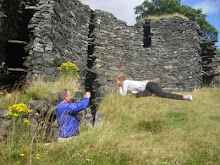
Remains of the Fair Dodhead, Ruberslaw in the background.

Jamie Telfer's tower by the 'Thieves Road' at the top of the Dod Burn is still there, very ruinous. The castle at Bewcastle, once home to the Duke of Gloucester, later Richard III, is now an impressive ruin. It was a military outpost in the 16th century, designed to deter Scottish reivers. Whether the Captain of Bewcastle really initiated raids into Teviotdale, we don't know. Fake news perhaps.

Bewcastle Churchyard and Castle

But the story rings true. Jamie Telfer, a simple farmer in an isolated tower house, is robbed of his ten cows. He manages to get a 'hot trod' (hot pursuit) going and they overtake the stolen beasts on the road back to England. The raiders turn and fight. Skulls are split, riders hit the ground, blood stains the snow and the kye (cattle) are recovered. The aggressor has relatives in Liddesdale. A reprisal raid heads off down there and these kye are driven back to Dodhead ...

When they cam to the fair Dodhead,
They were a wellcum sight to see!
For instead of his ain ten milk kye,
Jamie Telfer has gotten thirty and three.

Result!


Tuesday, July 21, 2020

Lord Dacre, Flodden and the Borders

Writing this, I keep coming up against Lord Dacre - specifically Thomas Dacre 2nd Baron of Gillsland (1467 - 1525) -  a perpetual thorn in the side of the Scots.

Firstly, a few years before Flodden, Dacre, as English Lord Warden of the Marches, Dacre met Sir Robert Kerr of Cessford Castle, Scottish Warden of the Middle March. It was a ‘Truce Day’ –  a day for the peaceful settlement of grievances. However, there was an argument, then a scuffle which ended up with Sir Robert being killed by three Englishmen: Lilburn, Starhead and the memorably named Heron the Bastard of Ford. The Scots managed to grab Lilburn, Starhead was tracked to a house in York, murdered, and the head brought back to Cessford; The ‘Bastard Heron’ escaped. Dacre's role in all this is unclear.


At Flodden, Dacre commanded the English Border Horse. Initially held in reserve, they then played a major role arriving in strength when Edmund Howard, son of the English commander Lord Surrey, was surrounded and so nearly captured by Lord Home's Borderers.

The Battle of Flodden 1513


Next morning, Dacre is the man who identified the stripped body of the Scottish king, James IV (with whom he had played cards!) and took it off the field. 

Two months after Flodden, Dacre was raiding in Teviotdale. He reports to his king...

On Thursday past I assembled your subjects in Northumberland to the number of a thousand horsemen and rode in at Gallespeth, and so to the Water of Kale, two miles within Scotland and there set forth two forays; my brother Philip Dacre with three hundred, who burnt and destroyed the the town of Ruecastle with all the corn in the same and there-about, and took two towers in it and burnt both roof and floors; and Sir Roger Fenwick with three hundred men burnt the town of Lanton, and destroyed all the corn therein.

He was at it again in 1514. But after raiding up the Ale Water some of his men were ambushed by the callants of Hawick at Hornshole and lost their flag - now the symbol of Hawick and its Common Riding.

Finally, Dacre was back in 1523. "In the morning of the day which was yesterday, we set forward and we went to Kelso where we not only burned and destroyed the whole town that would burn by any labour but also cast down the Gatehouse of the Abbey." 
Yes. We have him to blame.

So who was this swashbuckling destroyer?
Arms of Thomas, 2nd Lord Dacre

Born at Gillsland on Hadrian's Wall, son of a West March Warden and Governor of Carlisle, he was very much a Borderer. 

Aged 18 he was at the Battle of Bosworth Field, fighting for the House of York against the victorious House of Lancaster. But he quickly made his peace with the new King Henry VII, who later made him a Knight of the Bath.

Later that year (still 18!) he became Deputy Lord Warden of the Marches, then five years later in 1490, Warden of the West March .

Aged 21 he fell in love with  Elizabeth Greystoke, 17 year old ward of the powerful Lord Clifford. He abducted her by night from Brougham Castle in Westmorland. Somehow he got away with it, married her and they had eight children.

He seems to have been quite a friend of James IV, whose wedding he attended. When James visited Dumfries in 1504 he played cards against Dacre, who reportedly took him for £2 6s 8d!

From 1509 to 1525 he was Henry VIII's Lord Warden of the Marches, responsible for the entire border. And so it was that whilst he held this position, created to ensure peace along the Border, he was leading these various raids into Teviotdale.

He was clearly a warrior; he also knew how to have others do his dirty work for him. George MacDonald Fraser in 'Steel Bonnets' puts it like this...

"As a stirrer-up of mischief on the Scottish side of the frontier, intriguing among factions, enlisting Scots outlaws to harry their countrymen and promoting his monarch's policy of confusion and harm, he had few equals.

Dacre was in the saddle to the end, dying when he fell from his horse in 1525. He is buried in the family vault at Lanercost Priory. His son William succeeded him as Warden of the West March. 

Lanercost Priory near Brampton


Friday, October 04, 2019

The Nine: Scottish Dukes


10th Duke of Roxburghe,
by Allan Warren       
The Duke of Roxburghe died on 29th August. He was 64, a tragic victim of cancer. Guy Roxburghe was an impressive man in many ways and was given a substantial obituary in 'The Scotsman' and 'The Times'. 

However, his achievements would not have been quite so prominently aired had he been plain Mr.

Who are the Scottish Dukes? How relevant are they in 2019?

The oldest and most senior is the Duke of Rothesay (a pleasant town on the Isle of Bute). The title was first given to David Stewart, son of Robert III of Scotland, in 1398. After David’s death it went to his brother, later King James I. Thereafter, the heir apparent to the Scottish Crown has held this dukedom and it is now the title used by HRH Prince Charles when in Scotland.

The other eight dukedoms, with dates of creation, are:

Duke of Hamilton, 1643 (Head of the Houses of Hamilton and Douglas).
Duke of Buccleuch, 1663 (Created for Anne Countess of Buccleuch, widow of the Duke of Monmouth, illegitimate son of Charles II. Chief of Clan Scott)
Duke of Lennox, 1675 (Created for Charles Lennox, illegitimate son of  Charles II)
Duke of Queensberry, 1684 (now held by the Dukes of Buccleuch)
Duke of Argyll, 1701 (Chief of Clan Campbell)
Duke of Atholl, 1703 (Chief of Clan Murray)
Duke of Montrose, 1707(support in the Act of Union, Chief of Clan Graham)
Duke of Roxburghe, 1707 (support in the Act of Union) 

Floors Castle by Kelso. Home of the Duke of Roxburghe.
If you strip out Lennox (lives in England), Atholl (lives in South Africa) and Queensberry (also Buccleuch), we are left with five dukes: Hamilton, Buccleuch, Argyll, Montrose and Roxburghe.

As a body these five are quite impressive: all of them big or massive landowners, four of them clan chiefs and one (Montrose) sits in the House of Lords. The Dukes of Hamilton and Argyll also have ceremonial roles; the latter Master of the Household of Scotland, the former Hereditary Bearer of the Crown of Scotland.

Perhaps more significantly, our dukes own four of the most significant furnished castles in Scotland. The Dukes of Buccleuch have both the magnificent Drumlanrig Castle and charming Bowhill House near Selkirk. The Duke of Argyll has Inveraray Castle (fascinating in its own right and also featured in Downton Abbey!) and the late Duke of Roxburghe was responsible for creating from his splendid home, Floors Castle, with its gardens and grounds, a fascinating and relaxed half day visit.

Inveraray Castle, Argyll, home of the Duke of Argyll.


Wednesday, July 31, 2019

Where exactly is the Duchy of Albany?

Doune Castle
Visitors to the very fine Doune Castle will learn that it was built by Robert, Duke of Albany. Robert was the first person to own this enigmatic title which, unusually, has no relationship with any land. It was later given to the sons of kings prior to succeeding, or to younger sons (the best available title short of king). Other Dukes of Albany were Henry Lord Darnley, husband of Mary Queen of Scots, Charles I and James II.

The last Duke of Albany
Queen Victoria’s youngest son, Prince Leopold was created Duke of Albany in 1881, but was a haemophiliac and died aged 30. His son, Charles Edward, also reigning duke of Saxe-Coburg and Gotha, was deprived of his British peerages and honours for having fought in the German Army (eventually as a general) during WWI.

‘Albany’ comes from the Celtic word Alba, the island of Great Britain as opposed to Ierne, Ireland. When the southern part of Britain became Anglo-Saxon, the name settled on the Celtic lands north of the Forth and Clyde. Today it means Scotland and at the Scottish border you’ll see Fàilte gu Alba, Welcome to Scotland.

‘Albany’ is the Anglo-Saxon rendering of Alba (Cf. Brittany, Saxony, Lombardy). The title was first created in 1398  for the said Robert Stewart, builder of Doune Castle, second son of King Robert II, who was a ruthless Regent for three Scottish kings - his father, brother and nephew - who for various reasons were unable to rule effectively.

Charlotte, Duchess of Albany
‘Bonnie Prince Charlie’ latterly styled himself ‘Count of Albany’ and Charlotte, his daughter by Clementina Walkinshaw, was titled Duchess of Albany in the Jacobite Peerage. Charlotte herself had three illegitimate children, two girls and a son, Charles Edward, who became an officer in the Russian army. He told such tall tales of his origins and adventures that few believed his claims to royal descent until the 20th century when it was established that he was indeed who he had claimed to be. He died in 1854 as the result of a coach accident near Stirling Castle and is buried at Dunkeld Cathedral, where his grave can still be seen. He married twice but had no children.

But that, apparently, is not the end of the Duchy of Albany. At least not according to His Royal Highness Prince Michael of Albany, who styles himself 7th Duke of Albany due to his descent (6G grandson) from Prince Charles Edward Stuart through Comtesse Marguerite o’Dea d’Audibert de Lussan - not a familiar name to most. It’s a long story, told at length by Prince Michael in his book ‘The Forgotten Monarchy of Scotland’, available from Amazon in paperback £1.64p.


Wednesday, May 01, 2019

Clan Mackay

The Scottish Highlands was at one stage a patchwork of clan territories and I’m drawn to the idea of illuminating this heritage by re-establishing clan lands ‘on the ground’. Roadside signs announcing which bailiwick lies ahead would add character to our countryside and would also be great for tourism: members of the Diaspora would enjoy a surge of excitement, certain that they had arrived ‘home’.

Of course an agreed date would be needed because clan lands grew and contracted over the ages. And even then it wouldn’t be straightforward: the process of fixing the exact location of signs evokes a nice image of red-faced, kilted clan chiefs, tussling with cromachs to establish where boundaries belong.

Fanciful? Not entirely. With, so far as I know, no falling out with their neighbours, Clan Mackay staked out their territory back in 2004 with six "Mackay Country" signs. The lands are in the far North West and so signs were placed at KyleskuAchfary, Forsinard, Dalvina and on the A836 road at the Caithness/Sutherland border.


In Gaelic the name is rendered as Macaoidh, son of Hugh. They claim descent from both Somerled and the Celtic royal house, from both of whom they inherited a robust warrior spirit, much needed in early times as the Earls of Sutherland endeavoured to encroach on “Mackay Country”.

However by the 17th century their neighbours – Sinclairs, Sutherlands, MacLeods and Gunns - were presumably content and gave them relatively little trouble. The Mackays therefore had to go abroad for a fight: in 1626 Sir Donald Mackay took 3000 Mackays to fight for the King of Denmark in the Thirty Years' War. And in 1631 Lord Reay, the clan chief, raised another force for service with Gustavus Adolphus, King of Sweden; the earliest depiction of the kilt is assumed to be Mackays in the service of Gustavus Adolphus.


General Hugh Mackay of Scourie was a professional soldier. He fought the Turks on behalf of the Republic of Venice (1669), the French on behalf of the Dutch (1674) and commanded the army that faced the Jacobites at the Battle of Killiecrankie (1689), dying in the field at the Battle of Steinkirk (1692), in a doomed attack against the French, ordered by William of Orange (King William III)

During the Jacobite risings. Mackays were unwaveringly Hanoverian and produced two independent highland companies to oppose ‘Bonnie Prince Charlie. It was principally Mackays who won the skirmish at Littleferry near Golspie on 15 April 1746 and captured the Jacobite George Mackenzie, 3rd Earl of Cromartie at Dunrobin Castle.

The Clan Mackay Society is an active organisation, currently encouraging members to celebrate the tercentenary of the Battle of Gleshiel on the 9th of June – another occasion where idealistic Jacobites (this time including Rob Roy MacGregor) were defeated by hard-headed Hanoverians including the MacKays. 

If you venture up to Mackay Country don’t drive past the excellent Strathnaver Museum and find time if you can to walk up to Caisteal Bharraich.

Caisteal Bharraich


Monday, March 25, 2019

The Baronets of Nova Scotia and Bannockburn House


The above plaque, on the wall just by the entrance to Edinburgh Castle, is ignored by just about everyone. However this spot is, in some sense, a part of Nova Scotia, Canada and as a result, Baronetcies of Nova Scotia can be created here  - and were created here from 1624 to 1707.

It was all the idea of Sir William Alexander of Menstrie, courtier, poet and adventurer who took Nova Scotia, other parts of Maritime Canada, (and the present state of Maine) for his king, James VI of Scotland, 1st of England. In return he was given Long Island, New York which he sold! 

However most of the 329 Baronets of Nova Scotia lived happily in Scotland without so much as a look at the Atlantic, let alone crossing it. This was an early example of 'Cash for Honours'.

It is nicely summed up by Electric Scotland. He writes that Sir William suggested to his Majesty that "it might encourage development of a New Scotland if His Majesty were to offer a new order of baronets. The King liked the idea. After all, his creation of the Baronets of England in 1611 and the Baronets of Ireland in 1619 had raised £225,000 for the Crown. King James signed a grant in favour of Sir William Alexander covering all of the lands ‘ between our Colonies of New England and Newfoundland, to be known as New Scotland ’ (Nova Scotia in Latin), an area larger than Great Britain and France combined." 

About 100 of these baronetcies are still in existence. A display of the shields of the Arms of the Baronets of Nova Scotia is on display at Menstrie Castle.

Menstrie Castle
Most of these upwardly mobile lairds and their houses are forgotten by history, but the fine 17th century house of one has just had new life breathed into it. Sir Hugh Paterson of Bannockburn came from a family of staunch Lowland Jacobites and was convicted of treason after joining the 1715 Rising. He returned to Bannockburn and politics after the amnesty of 1717.

In 1746 during the siege of Stirling, Sir Hugh provided lodging for Bonnie Prince Charlie who fell ill of a fever and was nursed by Sir Hugh's niece, Clementina Walkinshaw, later the mother of his only child Charlotte.

Bannockburn House, just by the big Stirling interchange on the M9, was in private hands until bought recently by the community, www.bannockburnhouse.scot .

Bannockburn House


Sunday, March 10, 2019

Camelot by Kelso

Not many people go to Roxburgh Castle nowadays. It's a nice walk along the Borders Abbeys Way where Teviot joins Tweed, but nothing much to see...


In most history books it is only referred to as the place where King James II of Scotland was killed in 1460 by his own cannon exploding beside him (his nine year old son was then crowned James III in Kelso Abbey).

But before it was destroyed, Roxburgh Castle and its associated town to the east on what is now Friars Haugh, were a significant centre of power. In the time of King David I it was for a time the de facto capital of Scotland.

In the Middle Ages the town had as much importance as Edinburgh, Stirling or Perth; indeed it was the first recorded Scottish burgh. Situated on the Tweed, upstream from the major port of Berwick, and close by Dere Street, it was a substantial market town, exporting large quantities of raw wool and hides to Bruges, Ghent and beyond.

At that time the castle may have looked like this (with thanks to Andrew Spratt).


Roxburgh has also been closely associated with King Arthur, inspiring leader of a well disciplined mounted force that won a reported 13 battles, mostly in the lands north of Hadrian's Wall.

Writing about Roxburgh in his 'History of the Borders', historian Alistair Moffat writes, "Cavalry forts have special requirements and the castlemount and the wide haughland between the Tweed and the Teviot provide all of them...The ancient Celtic name of Roxburgh Castle was preserved and before the Angles came to change it, it was called Marchidun: in Old Welsh, the Horse Fort. Medieval and modern Arthurians would have preferred to call it Camelot."

Wednesday, February 27, 2019

The four hundred year rebellion


This month I attended the 327th anniversary of the massacre of Glencoe in my role as Finlaggan Pursuivant – herald to the Macdonald clan chiefs.

On February 13th 1692 Thirty or more Macdonalds of Glencoe were killed by government troops (mainly Campbells – the Argyll clan’s military effort was by this stage largely formalised along regimental lines within the army).

Laying a wreath at gloomy Glencoe, 327 later

The massacre is as famous as it is controversial. Historians still argue about the exact sequence of events, who ordered what, who was to blame, and what the historical significance of it all was.
What’s for sure is that it was not a stand alone incident. Glencoe came at the mid point of an extraordinary hundred year period in which the Highland clans payed a central role in the civil wars that defined modern Britain.

In 1645 Montrose was appointed ‘Captain General’ by Charles II and deployed a largely Highland and Highland/Irish army in support of the royalist side in the Civil War. The Stuarts called on the same support on numerous occasions until the final Jacobite defeat at Culloden in 1746.

So one way of looking at this is that it is the same long conflict flaring up over the century. It is striking that a similar group of clans joined each flare-up every time. They came for the most part from the central mainland west coast – the Macdonalds of Clanranald, Keppoch, Glengarry and Glencoe, with Camerons, Stewarts of Appin and others were a common denominator.

What motivated them?

The usual answer is loyalty to the Stuart cause. But, while clan leaders did use the rightness of the Stuart claim as justification, this is far from the whole story.

After all, the same group of clans had spent the previous three hundred years fighting the Stuarts. As recently as the 1620’s the Captain of Clanranald was writing to the Pope offering to lead a Catholic crusade against the Stuart government in Scotland. Indeed, the Clanranald Macdonalds lead a series of conflcicts against the Stuart monarchy throughout the 1500’s, and before that were a leading component of the Lordship of the Isles which struggled against Stuart mastery of Scotland for much of the middle ages. In practice, these Macdonalds were in more or less permanent ‘rebellion’ for four hundred years.

Clanranald and the others seem on the face of it to have pursued an obtuse strategy of persistent folly: Oppose the Stuarts when they are winning and then, as soon as the tide turns, join them to stay on the losing side (the Campbells, of course, did the opposite).

The answer to this paradox is perhaps that it was nothing to do with the Stuarts. It was nothing much to do with religion or culture either (although Clanranald was – and still is – Catholic, most allied clans were not).

Instead, the common thread that runs through all these conflicts, from the Lords of the Isles to Bonnie Prince Charlie – is hostility to whoever was running Scotland. These clans saw themselves as separate and somehow distinct politically from the Scottish (or British) state. It is hard to define this attitude exactly in the modern era of the nation state. The western clans did not necessarily claim a separate nationhood or statehood for themselves in the modern sense. But they reserved to right to pursue their own interests by force if necessary.

Tom Miers
For a memorable holiday exploring Scotland's heritage and culture, check out the Clans and Castles website


The Glencoe parade starts to assemble


Thursday, February 07, 2019

Let's Build a Broch!

Our guests on Clans and Castles 'Outlander Tours' know more or less what to expect: much-loved film locations, great countryside and a 'feel' for Scotland in the 18th century. But a visit that always surprises (and delights) them is the Glenelg brochs.

Brochs are double skinned, dry stone towers, originally 30 - 40 foot high. They are unique to Scotland and were built over a 300 year period around the time of Christ. The forerunner of the broch is the Atlantic round house, but those are much lower, less ambitious structures. Brochs emerged more or less from nowhere and then were, for some reason, no longer built.

Dun Telve, Glenelg
There were  about 500 brochs in Scotland, most of them on coasts where stone is readily available. Sadly, many have since been used as convenient quarries. Dun Telve (above) was depleted to build the nearby barracks at Bernera. The only broch still at its original height is Mousa, on a small island in Shetland.

Mousa Broch, Shetland
All brochs are round and very slightly concave, like a cooling tower. Apparently, if they were not double-skinned, they would collapse (I wonder how long it took to learn this!). Remember, they are built without mortar.

There's still a lot we don't know about brochs (not least why they were built). To improve our knowledge, the Caithness Broch Project aims to build a broch which will act as a visitor centre. It's an ambitious undertaking. Ian Armit, in his book 'Towers in the North', quotes an architect's estimate that building a broch would take 400 man days of specialist labour and 5,600 man days of unskilled assistance, assuming that the stone has first been gathered. I salute them!

PS. It is generally accepted that the brochs had a timber and thatch roof. Personally I cannot see how this could have been the case. Could iron age man have constructed a timber roof with a diameter of 18.3 metres (Dun Telve) ten metres above the ground? Would he go to all this trouble to live in darkness, the only light coming from a fire and a low door (which was presumably closed for much of the time)?

Wednesday, January 23, 2019

The enduring riddle of the Pictish symbol stones


They are the hieroglyphs of Scotland. But we have not yet found a Caledonian Rosetta Stone to interpret them.

There are thought to be about three dozen different ‘Pictish symbols’ carved in different combinations on a few hundred extant stones around Scotland – usually found in the traditional Pictish heartland of central and north-eastern Scotland. Some are combined with Christian symbology on magnificent stone crosses (or slabs with crosses engraved on them).

For a while after their conversion, the Picts used Christian images together with the old symbols. Sometimes it seems as if the crosses were engraved on older pagan stones. Many of them also include hunting scenes or other depictions of dark age aristocratic and military activity.

What they mean nobody knows for sure, even though numerous clans such as the MacGregors and MacNaghtens claim Pictish ancestry.

This magnificent specimen, which I visited last week, stands at Wester Fowlis in Strathearn, not far from the pretty spa town of Crieff. On one side is an extraordinary engraved cross, notable for its protruding arms. On the other, a series of hunting scenes with the tell-tale Pictish symbols of a ‘mirror’ and a ‘double disc’.


The one in the photo is actually a replica, with the real thing kept sheltered in the nearby church. It’s open and you can in and see it – a great example of the many historical sites and works of art that can be experiences for free in Scotland.

What do the symbols signify?

Some have speculated that, in different combinations, they depict various clans, territories, individual nobles or noblewoman. Although they are not usually located on burial sites, they may have religious connotations.

I feel sure that one day someone will either crack it logically or discover something that unlocks the code.

Maybe language has something to do with it. When I was a boy, it was thought that Pictish was a language largely separate from the two Celtic languages of northern Britain – Gaelic and Brittonic (early Welsh). Most scholars now think that it was similar to Brittonic.

Either way it was apparently replaced by Gaelic in the period after the union of the Picts and Scots in the early middle ages. As with the symbols, there is little hard evidence as to its nature.

But the idea that Pictish was eradicated by Gaelic has always seemed a little odd to me. The supposition is that the ruling elite became Gaelic speaking and, quite rapidly, imposed its language on everyone else. This didn’t really happen in other similar situations in the British Isles or elsewhere in Europe unless there was an accompanying movement of peoples.

Perhaps Pictish was really much more like Gaelic in the first place, and the clue to its symbology will come from that source.

At any rate, I have no real idea, except that it is a fascinating riddle!

Tom Miers
For a memorable holiday exploring Scotland's heritage and culture, check out the Clans and Castles website

Thursday, January 03, 2019

Mary Queen of Scots. Did you know?


The film will be with us soon and we'll see the dramatic (but fictional) meeting between Mary and her cousin Elizabeth. But here are a few facts about our tragic royal heroine.

1. Mary is one of the best known Scottish monarchs and yet she spent 18 years 8 months in England, 13 years in France. Only 12 years 5 months in Scotland (1542 - 48 and 1561- 68).

2. Mary was married three times. The marriage to Francis II of France lasted 26 months (Francis died). The second to Henry Lord Darnley lasted 18 months (Darnley was murdered), the last to James Hepburn, Earl of Bothwell technically lasted some years but after 30 days Mary was imprisoned and Bothwell fled.

3. When at Jedburgh, Mary nearly died of what was probably a gastric ulcer. Her French physician 'cured' her with tight bandaging of the arms and legs, and by inducing vomiting with an enema and large quantities of wine.

4 Mary went to France aged six as Marie Stewart but her French governess explained that 'ew' is pronounced 'ev' (it is in French!) and if you want 'Stooart' it must be spelled 'Stuart'. So she returned as Marie Stuart.

5. The day after Darnley's murder Mary attended the wedding of her bedchamber woman, Margaret Carwood. She is said to have played golf 'a few days' after the murder. She certainly married the man widely thought to have been the murderer (Bothwell) just three months and six days after the murder.

6. She was held in seven different castles in England. Nothing remains of the grand royal residence of Fotheringhay where she was executed on 8 February 1587.

7. Her descendants have been on the thrones of England and Scotland ever since.

Follow the Mary Queen of Scots trail  with Clans and Castles.


Monday, December 03, 2018

Neidpath Castle, a seat of Frasers, Hays, and Douglases


The Frasers are a Highland clan. Of course. But before that they were a Lowland clan, and their seat was here at NeidpathCastle on the Tweed, founded by Sir Gilbert Fraser in about 1190.  The last Fraser to own it was his descendant,  Sir Simon Fraser, known as 'The Patriot', for his astonishing feat of defeating three English armies in one day in 1303.  Detail is on Sarah Fraser's excellent blog, Patriot Games. The strawberry plant (fraise) can still be seen above the archway in the Neidpath courtyard.

The Patriot was executed in London in 1306 and his head stuck on a spike on Tower Bridge, next to that of William Wallace. His daughter Mary inherited a ruin but married Hay of Yester who rebuilt the castle, now all in stone and now of walls 10 foot thick with distinctive rounded corners. 

And Neidpath, overlooking a bend of the River Tweed just above Peebles, has dominated the Upper Tweed Valley ever since. Tower houses sprang up all over the Borders in the reiving times of the 16th century but in the 14th century there was really only Hermitage, Roxburgh and Neidpath. (Cessford and Newark followed in 1425 and 1465). One reason for its outlasting its contemporaries is the construction. A vaulted basement to carry the weight of a castle was normal, and sometimes a castle's top floor was vaulted; but Neidpath was built with three vaulted floors.
 
The castle was gradually extended and ‘modernised’, largely in the 16th century, and no doubt considerably spruced up for the visits of Mary Queen of Scots in 1563 and James VI in 1587 on expeditions to discipline the Border reivers. But the Hays were not reivers; they were establishment, becoming Earls of Tweeddale in 1646.

They sold the castle in 1686 to the Douglas Duke of Queensberry, whose granddaughter, they say, still restlessly walks the battlements. This is Lady Jean Douglas: having not been allowed to marry young Scott of Tushielaw in Ettrick, she pined for him and so became a shadow of herself, to the extent that, returning from exile, he didn’t recognise her; and she, wounded to the core, died of a broken heart. The tale was related by Sir Walter Scott who speaks of ‘cheerful evenings’ at the castle. However it was gradually abandoned as a dwelling in the 19th century,

Neidpath is once again roofed and available for events.  It also plays a significant role in the annual Peebles Beltane Festival. Each year a ‘Warden of Neidpath’ is appointed and has the honour of welcoming the Peebles Cornet, his lass and supporters to the castle from where they will ride the boundaries, an echo of the old reiving times, of course!

Warden of Neidpath, Bob Harrison, addressing the crowd at Neidpath in 2016


Sunday, November 05, 2017

Lord James Douglas, The Royal Scots and Louis XIV.

Lord James Douglas, who died in 1645 aged just 28, is buried in the church of Saint-Germain-des-Prés, Paris. Wandering through the church recently I was amazed to see the graves of both Lord James and his grandfather, 10th Earl of Angus (another interesting story). Not just graves but, in the case of Lord James, a massive monument in its own chapel, with a sculpture of him in white marble, all funded by King Louis XIV at a cost of 2900 livres. Anyone who has visited Versailles knows that Louis was a big spender, but to spend close on a million pounds commemorating a 28 year old foreigner...

Statue of Lord James Douglas, Saint Theresa Chapel, Saint-Germain-des-Prés, Paris.

Lord James, born at Douglas Castle in Lanarkshire, was “at an early age” a page in the court of Louis XIII of France. His father, a committed Roman Catholic in a predominantly protestant country, clearly didn’t enjoy life in the ruthless (and often rule-less) world of the South of Scotland. He was embroiled in a long legal dispute with the rough and reiving Kers of Ferniehirst over rights to hold courts in Jedforest, his brother was remanded in prison at Blackness Castle for threatening one of the Kers. It was all too much for this quiet and rather unhealthy earl. He left his estates to be looked after by others and lived for many years in France where he could practice his religion in peace and not be plagued by Border lairds.

Saint-Germain-des-Prés

His son Lord James was made of different stuff. He worked his way up in the French court and at the age of twenty, was appointed colonel of the ‘Scots Regiment’, which had been raised four years earlier in Scotland and was bound to King Louis, "in all service except against the King of Great Britain”. (The Auld Alliance in action).

This was the time of the 30 Years War and the regiment, now titled the Régiment de Douglas, took part in the siege of St. Omer in the Spanish Netherlands, fought in Piedmont under the Prince of Savoy, participated in the successful siege of Turin, and was then back in the Spanish Netherlands at the siege of Gravelines. The regiment 'fought with distinction' and its strength was increased to twenty companies of one hundred men each.  Lord James, however, was killed in a skirmish near Douai on 21 October 1645 during an attempt to take it from the Hapsburgs. On the very day of his death Louis XIV had indicated his wish to give him a Field-Marshal's baton.

Douglas was succeeded as colonel by his elder brother, Archibald Douglas, Earl of Angus. The Régiment de Douglas returned to British service in 1662, and in 1812 took its more famous name: The Royal Scots.