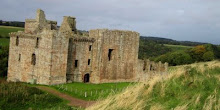
Not many people go to Roxburgh Castle nowadays. It's a nice walk along the Borders Abbeys Way where Teviot joins Tweed, but nothing much to see...
In most history books it is only referred to as the place where King James II of Scotland was killed in 1460 by his own cannon exploding beside him (his nine year old son was then crowned James III in Kelso Abbey).
But before it was destroyed, Roxburgh Castle and its associated town to the east on what is now Friars Haugh, were a significant centre of power. In the time of King David I it was for a time the de facto capital of Scotland.
In the Middle Ages the town had as much importance as Edinburgh, Stirling or Perth; indeed it was the first recorded Scottish burgh. Situated on the Tweed, upstream from the major port of Berwick, and close by Dere Street, it was a substantial market town, exporting large quantities of raw wool and hides to Bruges, Ghent and beyond.
At that time the castle may have looked like this (with thanks to Andrew Spratt).
Roxburgh has also been closely associated with King Arthur, inspiring leader of a well disciplined mounted force that won a reported 13 battles, mostly in the lands north of Hadrian's Wall.
Writing about Roxburgh in his 'History of the Borders', historian Alistair Moffat writes, "Cavalry forts have special requirements and the castlemount and the wide haughland between the Tweed and the Teviot provide all of them...The ancient Celtic name of Roxburgh Castle was preserved and before the Angles came to change it, it was called Marchidun: in Old Welsh, the Horse Fort. Medieval and modern Arthurians would have preferred to call it Camelot."
Sunday, March 10, 2019
Wednesday, February 27, 2019
The four hundred year rebellion
This month I attended the 327th anniversary of
the massacre of Glencoe in my role as Finlaggan Pursuivant – herald to the
Macdonald clan chiefs.
On February 13th 1692 Thirty or more Macdonalds
of Glencoe were killed by government troops (mainly Campbells – the Argyll
clan’s military effort was by this stage largely formalised along regimental
lines within the army).
![]() |
| Laying a wreath at gloomy Glencoe, 327 later |
The massacre is as famous as it is controversial. Historians
still argue about the exact sequence of events, who ordered what, who was to
blame, and what the historical significance of it all was.
What’s for sure is that it was not a stand alone incident.
Glencoe came at the mid point of an extraordinary hundred year period in which
the Highland clans payed a central role in the civil wars that defined modern
Britain.
In 1645 Montrose was appointed ‘Captain General’ by Charles
II and deployed a largely Highland and Highland/Irish army in support of the
royalist side in the Civil War. The Stuarts called on the same support on
numerous occasions until the final Jacobite defeat at Culloden in 1746.
So one way of looking at this is that it is the same long
conflict flaring up over the century. It is striking that a similar group of
clans joined each flare-up every time. They came for the most part from the
central mainland west coast – the Macdonalds of Clanranald, Keppoch, Glengarry
and Glencoe, with Camerons, Stewarts of Appin and others were a common
denominator.
What motivated them?
The usual answer is loyalty to the Stuart cause. But, while
clan leaders did use the rightness of the Stuart claim as justification, this
is far from the whole story.
After all, the same group of clans had spent the previous three
hundred years fighting the Stuarts. As recently as the 1620’s the Captain of
Clanranald was writing to the Pope offering to lead a Catholic crusade against
the Stuart government in Scotland. Indeed, the Clanranald Macdonalds lead a
series of conflcicts against the Stuart monarchy throughout the 1500’s, and
before that were a leading component of the Lordship of the Isles which
struggled against Stuart mastery of Scotland for much of the middle ages. In
practice, these Macdonalds were in more or less permanent ‘rebellion’ for four
hundred years.
Clanranald and the others seem on the face of it to have
pursued an obtuse strategy of persistent folly: Oppose the Stuarts when they
are winning and then, as soon as the tide turns, join them to stay on the
losing side (the Campbells, of course, did the opposite).
The answer to this paradox is perhaps that it was nothing to
do with the Stuarts. It was nothing much to do with religion or culture either
(although Clanranald was – and still is – Catholic, most allied clans were
not).
Instead, the common thread that runs through all these
conflicts, from the Lords of the Isles to Bonnie Prince Charlie – is hostility
to whoever was running Scotland. These clans saw themselves as separate and
somehow distinct politically from the Scottish (or British) state. It is hard
to define this attitude exactly in the modern era of the nation state. The
western clans did not necessarily claim a separate nationhood or statehood for
themselves in the modern sense. But they reserved to right to pursue their own
interests by force if necessary.
Tom Miers
For a memorable holiday exploring Scotland's heritage and culture, check out the Clans and Castles website
![]() |
| The Glencoe parade starts to assemble |
Thursday, February 07, 2019
Let's Build a Broch!
Our guests on Clans and Castles 'Outlander Tours' know more or less what to expect: much-loved film locations, great countryside and a 'feel' for Scotland in the 18th century. But a visit that always surprises (and delights) them is the Glenelg brochs.
Brochs are double skinned, dry stone towers, originally 30 - 40 foot high. They are unique to Scotland and were built over a 300 year period around the time of Christ. The forerunner of the broch is the Atlantic round house, but those are much lower, less ambitious structures. Brochs emerged more or less from nowhere and then were, for some reason, no longer built.
![]() |
| Dun Telve, Glenelg |
There were about 500 brochs in Scotland, most of them on coasts where stone is readily available. Sadly, many have since been used as convenient quarries. Dun Telve (above) was depleted to build the nearby barracks at Bernera. The only broch still at its original height is Mousa, on a small island in Shetland.
![]() |
| Mousa Broch, Shetland |
All brochs are round and very slightly concave, like a cooling tower. Apparently, if they were not double-skinned, they would collapse (I wonder how long it took to learn this!). Remember, they are built without mortar.
There's still a lot we don't know about brochs (not least why they were built). To improve our knowledge, the Caithness Broch Project aims to build a broch which will act as a visitor centre. It's an ambitious undertaking. Ian Armit, in his book 'Towers in the North', quotes an architect's estimate that building a broch would take 400 man days of specialist labour and 5,600 man days of unskilled assistance, assuming that the stone has first been gathered. I salute them!
PS. It is generally accepted that the brochs had a timber and thatch roof. Personally I cannot see how this could have been the case. Could iron age man have constructed a timber roof with a diameter of 18.3 metres (Dun Telve) ten metres above the ground? Would he go to all this trouble to live in darkness, the only light coming from a fire and a low door (which was presumably closed for much of the time)?
Wednesday, January 23, 2019
The enduring riddle of the Pictish symbol stones
They are the hieroglyphs of Scotland. But we have not yet found a Caledonian Rosetta Stone to interpret them.
There are thought to be about three dozen different ‘Pictish
symbols’ carved in different combinations on a few hundred extant stones around
Scotland – usually found in the traditional Pictish heartland of central and
north-eastern Scotland. Some are combined with Christian symbology on
magnificent stone crosses (or slabs with crosses engraved on them).
For a while after their conversion, the Picts used Christian
images together with the old symbols. Sometimes it seems as if the crosses were
engraved on older pagan stones. Many of them also include hunting scenes or other
depictions of dark age aristocratic and military activity.
What they mean nobody knows for sure, even though numerous
clans such as the MacGregors and MacNaghtens claim Pictish ancestry.
This magnificent specimen, which I visited last week, stands at Wester Fowlis in
Strathearn, not far from the pretty spa town of Crieff. On one side is an
extraordinary engraved cross, notable for its protruding arms. On the other, a series
of hunting scenes with the tell-tale Pictish symbols of a ‘mirror’ and a
‘double disc’.
The one in the photo is actually a replica, with the real
thing kept sheltered in the nearby church. It’s open and you can in and see it
– a great example of the many historical sites and works of art that can be
experiences for free in Scotland.
What do the symbols signify?
Some have speculated that, in different combinations, they
depict various clans, territories, individual nobles or noblewoman. Although
they are not usually located on burial sites, they may have religious
connotations.
I feel sure that one day someone will either crack it
logically or discover something that unlocks the code.
Maybe language has something to do with it. When I was a
boy, it was thought that Pictish was a language largely separate from the two
Celtic languages of northern Britain – Gaelic and Brittonic (early Welsh). Most
scholars now think that it was similar to Brittonic.
Either way it was apparently replaced by Gaelic in the
period after the union of the Picts and Scots in the early middle ages. As with
the symbols, there is little hard evidence as to its nature.
But the idea that Pictish was eradicated by Gaelic has
always seemed a little odd to me. The supposition is that the ruling elite
became Gaelic speaking and, quite rapidly, imposed its language on everyone
else. This didn’t really happen in other similar situations in the British
Isles or elsewhere in Europe unless there was an accompanying movement of
peoples.
Perhaps Pictish was really much more like Gaelic in the
first place, and the clue to its symbology will come from that source.
At any rate, I have no real idea, except that it is a
fascinating riddle!
Tom Miers
For a memorable holiday exploring Scotland's heritage and culture, check out the Clans and Castles website
Tom Miers
For a memorable holiday exploring Scotland's heritage and culture, check out the Clans and Castles website
Thursday, January 03, 2019
Mary Queen of Scots. Did you know?
The film will be with us soon and we'll see the dramatic (but fictional) meeting between Mary and her cousin Elizabeth. But here are a few facts about our tragic royal heroine.
1. Mary is one of the best known Scottish monarchs and yet she spent 18 years 8 months in England, 13 years in France. Only 12 years 5 months in Scotland (1542 - 48 and 1561- 68).
2. Mary was married three times. The marriage to Francis II of France lasted 26 months (Francis died). The second to Henry Lord Darnley lasted 18 months (Darnley was murdered), the last to James Hepburn, Earl of Bothwell technically lasted some years but after 30 days Mary was imprisoned and Bothwell fled.
3. When at Jedburgh, Mary nearly died of what was probably a gastric ulcer. Her French physician 'cured' her with tight bandaging of the arms and legs, and by inducing vomiting with an enema and large quantities of wine.
4 Mary went to France aged six as Marie Stewart but her French governess explained that 'ew' is pronounced 'ev' (it is in French!) and if you want 'Stooart' it must be spelled 'Stuart'. So she returned as Marie Stuart.
5. The day after Darnley's murder Mary attended the wedding of her bedchamber woman, Margaret Carwood. She is said to have played golf 'a few days' after the murder. She certainly married the man widely thought to have been the murderer (Bothwell) just three months and six days after the murder.
6. She was held in seven different castles in England. Nothing remains of the grand royal residence of Fotheringhay where she was executed on 8 February 1587.
7. Her descendants have been on the thrones of England and Scotland ever since.
Follow the Mary Queen of Scots trail with Clans and Castles.
Monday, December 03, 2018
Neidpath Castle, a seat of Frasers, Hays, and Douglases
The Frasers are a Highland clan. Of course. But
before that they were a Lowland clan, and their seat was here at NeidpathCastle on the Tweed, founded by Sir Gilbert Fraser in about 1190.
The last Fraser to own it was his descendant, Sir Simon
Fraser, known as 'The Patriot', for his astonishing feat of defeating three
English armies in one day in 1303. Detail is on Sarah Fraser's excellent
blog, Patriot Games. The strawberry plant (fraise) can still
be seen above the archway in the Neidpath courtyard.
The Patriot was executed in London in 1306 and his
head stuck on a spike on Tower Bridge, next to that of William Wallace. His
daughter Mary inherited a ruin but married Hay of Yester who rebuilt the
castle, now all in stone and now of walls 10 foot thick with distinctive
rounded corners.
The castle was gradually extended and
‘modernised’, largely in the 16th century, and no doubt considerably
spruced up for the visits of Mary Queen of Scots in 1563 and James VI in 1587
on expeditions to discipline the Border reivers. But the Hays were not reivers;
they were establishment, becoming Earls of Tweeddale in 1646.
They sold the castle in 1686 to the Douglas Duke of Queensberry, whose granddaughter, they say, still restlessly walks the battlements. This is Lady Jean Douglas: having not been allowed to marry young Scott of Tushielaw in Ettrick, she pined for him and so became a shadow of herself, to the extent that, returning from exile, he didn’t recognise her; and she, wounded to the core, died of a broken heart. The tale was related by Sir Walter Scott who speaks of ‘cheerful evenings’ at the castle. However it was gradually abandoned as a dwelling in the 19th century,
Neidpath is once again roofed and available for events. It also
plays a significant role in the annual Peebles Beltane Festival. Each year a ‘Warden of
Neidpath’ is appointed and has the honour of welcoming the Peebles Cornet, his
lass and supporters to the castle from where they will ride the boundaries, an
echo of the old reiving times, of course!
![]() |
| Warden of Neidpath, Bob Harrison, addressing the crowd at Neidpath in 2016 |
Sunday, November 05, 2017
Lord James Douglas, The Royal Scots and Louis XIV.
Lord James Douglas, who died in 1645 aged just 28, is buried in the church of Saint-Germain-des-Prés, Paris. Wandering through the church recently I was amazed to see the graves of both Lord James and his grandfather, 10th Earl of Angus (another interesting story). Not just graves but, in the case of Lord James, a massive monument in its own chapel, with a sculpture of him in white marble, all funded by King Louis XIV at a cost of 2900 livres. Anyone who has visited Versailles knows that Louis was a big spender, but to spend close on a million pounds commemorating a 28 year old foreigner...
His son Lord James was made of different stuff. He worked his way up in the French court and at the age of twenty, was appointed colonel of the ‘Scots Regiment’, which had been raised four years earlier in Scotland and was bound to King Louis, "in all service except against the King of Great Britain”. (The Auld Alliance in action).
![]() |
| Statue of Lord James Douglas, Saint Theresa Chapel, Saint-Germain-des-Prés, Paris. |
Lord James, born at Douglas Castle in Lanarkshire, was “at an early age” a page in the court of Louis XIII of France. His father, a committed Roman Catholic in a predominantly protestant country, clearly didn’t enjoy life in the ruthless (and often rule-less) world of the South of Scotland. He was embroiled in a long legal dispute with the rough and reiving Kers of Ferniehirst over rights to hold courts in Jedforest, his brother was remanded in prison at Blackness Castle for threatening one of the Kers. It was all too much for this quiet and rather unhealthy earl. He left his estates to be looked after by others and lived for many years in France where he could practice his religion in peace and not be plagued by Border lairds.
![]() |
| Saint-Germain-des-Prés |
His son Lord James was made of different stuff. He worked his way up in the French court and at the age of twenty, was appointed colonel of the ‘Scots Regiment’, which had been raised four years earlier in Scotland and was bound to King Louis, "in all service except against the King of Great Britain”. (The Auld Alliance in action).
This was the time of the 30 Years War and the regiment, now titled the Régiment de Douglas, took part in the siege of St. Omer in the Spanish Netherlands, fought in Piedmont under the Prince of Savoy, participated in the successful siege of Turin, and was then back in the Spanish Netherlands at the siege of Gravelines. The regiment 'fought with distinction' and its strength was increased to twenty companies of one hundred men each. Lord James, however, was killed in a skirmish near Douai on 21 October 1645 during an attempt to take it from the Hapsburgs. On the very day of his death Louis XIV had indicated his wish to give him a Field-Marshal's baton.
Douglas was succeeded as colonel by his elder brother, Archibald Douglas, Earl of Angus. The Régiment de Douglas returned to British service in 1662, and in 1812 took its more famous name: The Royal Scots.
Thursday, May 05, 2016
Flodden 1513
The most recent Scots Heritage Magazine has a piece on the feud between the Montgomery and Cunningham families in the 15th/16th centuries. It's a depressing story but I read it anyway: castles burned with folk inside them, a parade of individuals ambushed and murdered. Gory even for Scotland at this time. It went on until well into the 17th century (when James VI called a halt) but there was a pause in 1513 when, as the author Margaret Skea notes, "private grievances were set aside in the face of an English threat".
Look into the history of any Scottish name and you will wince at what was lost at Flodden in 1513. Not just our best king since Robert the Bruce, but 10,000 men including most of Scotland's nobility. William Cunningham 1st Laird of Craigends, son of the first Earl of Glencairn, died (his father died fighting the English at Sauchieburn in 1488). Hugh Montgomerie, 1st Earl of Eglinton, fought and escaped. Their neighbour in the south west, David Kennedy, 1st Earl of Cassilis died.
Kings of Scots at this time struggled to make their writ run throughout what they considered to be their kingdom, but the Flodden dead came from all parts. Archibald Campbell 2nd Earl of Argyll and Hector, 9th Chief of Clan MacLean in the west; from the north William Sinclair 2nd Earl of Caithness; from the north east William Graham, 1st Earl of Montrose and both sons of William Keith, 3rd Earl Marischal.
Quite naturally most came from the Borders. Every year at Selkirk as part of the Common Riding celebrations, the town's Standard Bearer recalls Fletcher, the town's sole survivor, who returned with a captured English banner and when asked where the other men were, he silently laid it on the ground.
I was at Flodden yesterday (it's about an hour from my house) on a fine spring afternoon. Between the monument and Branxton Hill is 'the boggy ground' where about 10,000 Scots died. Now it is drained and under efficient cultivation. A monument was erected nearby in 1910. The dozens killed in the Montgomery-Cunningham feud are inconsequential by comparison.
And if you ask what the battle was all about...it's complicated. James IV aimed to relieve pressure on his ally the King of France but Niall Barr in his excellent book on Flodden also notes, "James had achieved much in his reign, but he had never won a pitched battle - which remained the ultimate accolade for a Renaissance prince". We've had a few frustrated would-be princes ready to sacrifice lives in our 21st century too.
| The Flodden Monument |
Look into the history of any Scottish name and you will wince at what was lost at Flodden in 1513. Not just our best king since Robert the Bruce, but 10,000 men including most of Scotland's nobility. William Cunningham 1st Laird of Craigends, son of the first Earl of Glencairn, died (his father died fighting the English at Sauchieburn in 1488). Hugh Montgomerie, 1st Earl of Eglinton, fought and escaped. Their neighbour in the south west, David Kennedy, 1st Earl of Cassilis died.
Kings of Scots at this time struggled to make their writ run throughout what they considered to be their kingdom, but the Flodden dead came from all parts. Archibald Campbell 2nd Earl of Argyll and Hector, 9th Chief of Clan MacLean in the west; from the north William Sinclair 2nd Earl of Caithness; from the north east William Graham, 1st Earl of Montrose and both sons of William Keith, 3rd Earl Marischal.
Quite naturally most came from the Borders. Every year at Selkirk as part of the Common Riding celebrations, the town's Standard Bearer recalls Fletcher, the town's sole survivor, who returned with a captured English banner and when asked where the other men were, he silently laid it on the ground.
![]() |
| Selkirk Common Riding |
I was at Flodden yesterday (it's about an hour from my house) on a fine spring afternoon. Between the monument and Branxton Hill is 'the boggy ground' where about 10,000 Scots died. Now it is drained and under efficient cultivation. A monument was erected nearby in 1910. The dozens killed in the Montgomery-Cunningham feud are inconsequential by comparison.
And if you ask what the battle was all about...it's complicated. James IV aimed to relieve pressure on his ally the King of France but Niall Barr in his excellent book on Flodden also notes, "James had achieved much in his reign, but he had never won a pitched battle - which remained the ultimate accolade for a Renaissance prince". We've had a few frustrated would-be princes ready to sacrifice lives in our 21st century too.
Wednesday, January 06, 2016
The Scots who migrated to Bath.
The mineral-rich hot springs of Bath, Somerset, England still bubble away, as they did in Roman times. As they did in 1687 when Mary of Modena, wife of James II, visited there desperately hoping for a healthy child and nine months later James, father of 'Bonnie Prince Charlie', was born. As they did when it was the most fashionable resort in Georgian times.
Unusually, I was in Bath over Hogmanay, attending a wedding in the wonderful 16th century abbey. Drawn back there next day my eye wandered over the 641 marble plaques on the walls and saw a remarkable number of Scots featured. I started to write down the details and whilst I certainly did not get them all, I noted 31; details are below (but 100% accuracy is not guaranteed).
I have half an answer. Many were ex-military or ex-Civil Service and having served all round the world, joined others in fashionable Bath, inhabiting those famous Georgian houses and hoping that the curing waters would prolong their lives. I can also vouch for the fact that it is a little warmer there in winter. But still, if Scots lay claim to 5% of all the plaques, was fashionable Bath really 5% Scottish in the 18th century?
The list of those remembered in Bath Abbey (chronological order).
Margaret Pringle, daughter of Sir Robert Pringle of Stichill in the County of Teviotdale, in Scotland, Baronet and wife of William Drummond of Grange in the County of Stirling Esq, who died 26th August 1728, aged 48.
George Gordon of Gight in Aberdeenshire, died 9 January 1779.
Sir Patrick Houston of Houston in North Britain, Baronet who
died 24 March 1785 in the 43rd year of his age.
Duncan Grant of Mullochard, North Britain, died 1 January 1788, aged 59.
John Hay Balfour Esq of Leys, Perthshire, North Britain who
died 28 February 1791.
Charles Lockhart of Muiravonside in the County of Stirling,
died 3 February 1796, aged 55.
Adam Gordon of Lime Street London, 5th son of Charles Gordon
Esq, of Abergeldie, in the county of Aberdeen, North Britain, died 28 May 1800, aged 42 years
Helen, Countess of Selkirk, relict of Dunbar Earl Selkirk, who
died 29 November 1802, aged 65.
Alexander Ellice Esq, born Anchelys, Aberdeenshire June 15th
1743 and died at Bath, 28 September 1805. Anne, his widow, died at Bath April 30th
1847. Sacred also to the memory of Charles, son of Alexander and Anne Ellice.
Born December 10th 1797, died March 10th 1799.
Mary Anne Leycester Sturt, youngest daughter of Thomas Lenox Napier
Sturt & James, his wife. Died 19 February 1812, aged 2 years 5 months.
Alicia, Countess of Erroll, died 24 April 1812 in the 35th
year of her age.
William Kennedy Lawrie of Red Castle, Galloway, late of St
Thomas in East Jamaica, died 28 January 1811, aged 62.
John McDougall Vice Admiral of Red of His Majesty`s Fleet, died
21 November 1814, aged 66.
John Maclean Esq of Inverscardle, North Britain, died 27 April
1812, aged 72.
John White Melville of Bennochy and Strathkinnes in Fifeshire,
Scotland, died 27 May, 1813, aged 59.
The Honourable Colonel Cosmo Gordon, brother of the late Earl
of Aberdeen and Uncle to the present Duke of Gordon, died 27th February 1813 in
his 76th year.
Colin Mackenzie, son of the late Sir Lewis Mackenzie of
Scatewell, North Britain, died 3 February 1814, aged 66. Janet, relict of the
above, died 19 July 1817 aged 57.
Lt General Elliot, late Commandant of Royal Marines, died 16th
April 1820 in the 88th year of his age.
John Campbell, 1st Lord Cawdor who died 1st June 1821 in the 68th
year of his age.
Hugh Campbell Esq of Mayfield in the County of Ayr, North
Britain, late Captain in His Majesty's 85th Regt. Died 5 January 1824, aged 51.
John Ewart Christie, Royal Marines and late Lt Col of the
Nithsdale Militia, died 27 July 1828, aged 74.
James Sholto Douglas Esq, died January 12 1830 Aged 72. Also of
Anne Elizabeth his second daughter who died March 13th 1842.
William Murray Esq of Glencaird, Stewartry of Kirkcudbright.
Died 14 April 1833, aged 83.
Anne, widow of the Hon George Mackay and mother of Eric, 7th
Lord Reay, died 15 March 1833, aged 82.
David Monro Esq, formerly of Quebec, lower Canada. He died September 3rd 1834, aged 74 years.
Lt General Sir Thomas Dallas, GCB, died 12 August 1839. Anne,
his widow, died 30 April 1847.
Col the Hon Aeneas Mackay, 3rd son of the 2nd Lord Reay who
died in the service of the States General. His descendants settled in the
Netherlands and to them the Scottish Barony descended in 1875.
Tuesday, December 29, 2015
General Hugh Mercer: Jacobite, Doctor, Symbol of the American Revolution
General Hugh Mercer was a Jacobite who fought at the Battle of Culloden (1746) as a 20 year old surgeon and died as a general in George Washington's Continental Army, fatally wounded at the Battle of Princeton in 1777, now aged 51. Washington said of him, "In his experience and judgement you may repose great confidence."
From 1 April 2016 there will be a permanent exhibition at the Fraserburgh Heritage Centre (up on Scotland's North East Coast) highlighting this famous son of the area.
Born at Pitsligo Kirk Manse (near Fraserburgh) in 1726, he studied medicine at Marischal College Aberdeen from age 15. In 1745 he enlisted in the Jacobite Army (Pitsligo's Regiment of Horse) as a Surgeon. Fighting alongside him was his cousin, Thomas Mercer of Auchnacant, an Aide de Camp.
Following the disaster of Culloden, Mercer spent months in hiding, and in 1747 bought his way on to a ship and settled at Mercersburg, Pennsylvania where he practised medicine.
Eight years later, his taste for adventure resurfaced and he joined the British Army, not as a doctor but as an infantry officer, and was prominent in the struggle against the French for Fort Duquesne. Having captured the fort and (now renamed Fort Pitt, the origin of Pittsburg) in 1758 Colonel Mercer was left in charge and at one stage the new fort was recorded as 'Mercer's Fort'.
He returned to medicine in Fredericksburg Virginia where he married and had five children. At the outset of the Revolution in 1776, he joined George Washington and is credited with the plan to cross the iced over Delaware and surprise the British Army at Trenton. Next month, though, his brigade became separated from the main army on the way to Princetown and he died of his wounds. There is a memorial plaque outside the house where he died.
Amongst Mercer's many descendants was General George S. Patton Jr. of World War Two fame.
Some might comment that, although he looks very much a part of the establishment, he was a rebel all his life!
![]() |
| General Hugh Mercer Memorial Statue, Washington District, Fredericksburg, Virginia. |
Thursday, August 06, 2015
Clashing Cultures
I watched episode nine of the Outlander TV series last night... where Jamie takes his belt to Claire for her disobedience: "You've done wrong to all the men and you must suffer for it". She then twice makes him promise, at the point of a dirk, never to do such a thing again. This tension between cultures is one of the charms of the books and Diana Gabaldon has put her finger on an enduring issue.
For Claire, an intelligent liberated woman of the 20th century, such barbarity is unacceptable, indeed contemptible. But, stripped of modern ethical standards, clan society in the 18th century worked pretty well, and Claire was operating in a cultural vacuum (her culture had not yet been born!).
The episode put me in mind of Alistair Moffat's comments in his excellent book on Hadrian's Wall, on the relative barbarism of Romans and the invaded, artistic but illiterate Celts, "In AD 105 the Emperor Trajan sent 50,000 captives back to Rome to be butchered by gladiators for the amusement of spectators... very civilised".
Where a culture has superior military power, it somehow believes that its values are superior to those who are less developed, less able to defend themselves.
In 1919 the Aliab Dinka of Southern Sudan, naked, spear-carrying cattle herders were not paying their taxes and, when confronted, had the temerity to outwit the government forces and kill the provincial governor. The Lewis gun equipped punitive expedition burned villages and drove off 7000 cattle, sold to fund the occupying force. Who were the Barbarians?
Moffat also writes of the aftermath of Queen Boudica's rebellion, "Paullinus scoured the countryside for fugitives, allies, or even neutrals... smoke rose on every horizon as the soldiers punished southern Britain for daring to rebel". The same man dealt with the island of Anglesey, "In the days after the battle the killing went on: Paullinus ordered his men to cut down the sacred groves of oak trees on Mona, and as far as possible extirpate the cult of the druids".
The extirpation of a cult was more or less exactly what the Duke of Cumberland had in mind with his brutal and indiscriminate suppression of the Highlands in 1746. The violence and sense of superiority of the British Army of the day is only a little exaggerated in the TV series.
That was 270 years ago. But the conviction that more developed cultures are superior (and should be imposed) still endures.
For Claire, an intelligent liberated woman of the 20th century, such barbarity is unacceptable, indeed contemptible. But, stripped of modern ethical standards, clan society in the 18th century worked pretty well, and Claire was operating in a cultural vacuum (her culture had not yet been born!).
The episode put me in mind of Alistair Moffat's comments in his excellent book on Hadrian's Wall, on the relative barbarism of Romans and the invaded, artistic but illiterate Celts, "In AD 105 the Emperor Trajan sent 50,000 captives back to Rome to be butchered by gladiators for the amusement of spectators... very civilised".
Where a culture has superior military power, it somehow believes that its values are superior to those who are less developed, less able to defend themselves.
In 1919 the Aliab Dinka of Southern Sudan, naked, spear-carrying cattle herders were not paying their taxes and, when confronted, had the temerity to outwit the government forces and kill the provincial governor. The Lewis gun equipped punitive expedition burned villages and drove off 7000 cattle, sold to fund the occupying force. Who were the Barbarians?
The extirpation of a cult was more or less exactly what the Duke of Cumberland had in mind with his brutal and indiscriminate suppression of the Highlands in 1746. The violence and sense of superiority of the British Army of the day is only a little exaggerated in the TV series.
That was 270 years ago. But the conviction that more developed cultures are superior (and should be imposed) still endures.
Subscribe to:
Posts (Atom)