This month I attended the 327th anniversary of
the massacre of Glencoe in my role as Finlaggan Pursuivant – herald to the
Macdonald clan chiefs.
On February 13th 1692 Thirty or more Macdonalds
of Glencoe were killed by government troops (mainly Campbells – the Argyll
clan’s military effort was by this stage largely formalised along regimental
lines within the army).
 |
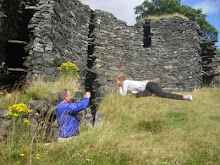
| Laying a wreath at gloomy Glencoe, 327 later |
The massacre is as famous as it is controversial. Historians
still argue about the exact sequence of events, who ordered what, who was to
blame, and what the historical significance of it all was.
What’s for sure is that it was not a stand alone incident.
Glencoe came at the mid point of an extraordinary hundred year period in which
the Highland clans payed a central role in the civil wars that defined modern
Britain.
In 1645 Montrose was appointed ‘Captain General’ by Charles
II and deployed a largely Highland and Highland/Irish army in support of the
royalist side in the Civil War. The Stuarts called on the same support on
numerous occasions until the final Jacobite defeat at Culloden in 1746.
So one way of looking at this is that it is the same long
conflict flaring up over the century. It is striking that a similar group of
clans joined each flare-up every time. They came for the most part from the
central mainland west coast – the Macdonalds of Clanranald, Keppoch, Glengarry
and Glencoe, with Camerons, Stewarts of Appin and others were a common
denominator.
What motivated them?
The usual answer is loyalty to the Stuart cause. But, while
clan leaders did use the rightness of the Stuart claim as justification, this
is far from the whole story.
After all, the same group of clans had spent the previous three
hundred years fighting the Stuarts. As recently as the 1620’s the Captain of
Clanranald was writing to the Pope offering to lead a Catholic crusade against
the Stuart government in Scotland. Indeed, the Clanranald Macdonalds lead a
series of conflcicts against the Stuart monarchy throughout the 1500’s, and
before that were a leading component of the Lordship of the Isles which
struggled against Stuart mastery of Scotland for much of the middle ages. In
practice, these Macdonalds were in more or less permanent ‘rebellion’ for four
hundred years.
Clanranald and the others seem on the face of it to have
pursued an obtuse strategy of persistent folly: Oppose the Stuarts when they
are winning and then, as soon as the tide turns, join them to stay on the
losing side (the Campbells, of course, did the opposite).
The answer to this paradox is perhaps that it was nothing to
do with the Stuarts. It was nothing much to do with religion or culture either
(although Clanranald was – and still is – Catholic, most allied clans were
not).
Instead, the common thread that runs through all these
conflicts, from the Lords of the Isles to Bonnie Prince Charlie – is hostility
to whoever was running Scotland. These clans saw themselves as separate and
somehow distinct politically from the Scottish (or British) state. It is hard
to define this attitude exactly in the modern era of the nation state. The
western clans did not necessarily claim a separate nationhood or statehood for
themselves in the modern sense. But they reserved to right to pursue their own
interests by force if necessary.
Tom Miers
For a memorable holiday exploring Scotland's heritage and culture, check out the Clans and Castles website
 |
| The Glencoe parade starts to assemble |


 Posts
Posts